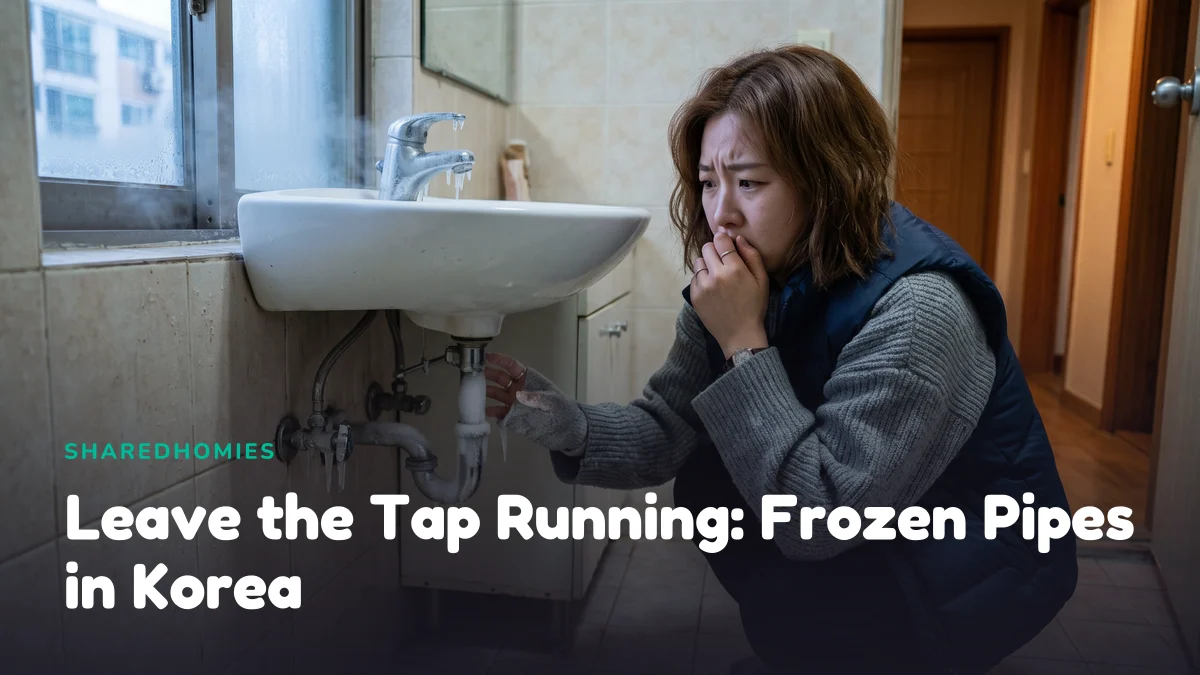
Leave the Tap Running: How to Stop Frozen Pipes in Korea (and What a Burst Costs)

- Below −5°C overnight: trickle the cold bathroom tap.
- Below −10°C: fill a paper cup in about 33 seconds.
- Boiler on 외출 (away) when out. Never switch it off.
- Ten hours of trickle costs under ₩300 in Seoul.
- Neglect-caused freeze damage comes out of a SharedHomies deposit.
When Seoul drops below −5°C, leave the cold bathroom tap trickling overnight and every time you go out, and put the boiler on 외출 (away) instead of switching it off. Below −10°C, open the tap until it fills a paper cup in about 33 seconds — Seoul's own guideline, and it costs under ₩300 for ten hours (Seoul Metropolitan Government). A frozen meter costs about ₩41,000 to replace, a boiler part ₩500,000–₩1,000,000, and a burst pipe under the floor or above a neighbour's ceiling can run into the millions. Two habits prevent almost all of it.
- Cold bathroom tap: trickle. A thin, steady stream, not drops. Below −10°C: a paper cup in about 33 seconds.
- Boiler: 외출 (away) or about 15°C. Never 전원 off, never unplugged.
- Going out for the day or a trip? Same two steps before you leave.
- Water stopped or hot water gone? Message us straight away. No kettles, no lighters, no hairdryers on the pipes.
Nothing you have to buy. Know three things:
- Which tap. The cold tap on the bathroom sink is the standard one in our houses, and it is what Korean building notices point to.
- Your boiler panel. Find the 외출 (away) button. Not sure which one it is? Look your panel up in our boiler finder.
- Tonight's low. Any weather app. Seoul also issues freeze alerts at four levels, below.
Whenever the overnight low is −5°C or colder: overnight, and whenever the room is empty. Seoul's waterworks issues a four-level freeze forecast every winter from 15 November to 15 March (Seoul Metropolitan Government). Here is what each level means for you:
| Seoul alert (동파 예보) | Daily low | What you do |
|---|---|---|
| 관심 (watch) | Above −5°C | Boiler on 외출 when out. No trickle needed. |
| 주의 (caution) | −5°C to −10°C | Trickle the cold tap overnight and whenever you are out. |
| 경계 (warning) | −10°C to −15°C, 2+ days | Trickle harder: a paper cup in about 33 seconds. |
| 심각 (severe) | Below −15°C, 2+ days | Same as 경계, even for a short trip out. Do not skip a single night. |
Thresholds are Seoul's (Seoul Metropolitan Government). The house rule at −5°C is ours: our buildings are older than the apartments the city has in mind, and one missed night is enough.
Moving water is much harder to freeze than still water, and a trickle keeps the cold supply pipe moving all night. The pipe that freezes first is usually the one between the water meter and your tap, often in an outside wall, a hallway meter box or an unheated corner. When it freezes the ice expands, the pipe or the meter's glass face cracks, and nothing happens until it thaws. Then the water comes out.
 A frozen tap. The ice you can see is the small part. Photo: Paul van de Velde, CC BY 2.0.

Seoul's own numbers show where it goes wrong. Of about 7,700 frozen meters in the winter of 2022–23, 97% froze in homes that were empty for a long stretch or poorly insulated (Seoul Metropolitan Government). The winter before, poor insulation caused 67.7% and long absences 24% (Seoul Metropolitan Government). An empty room on a cold night is the classic case: you're away for the weekend, the boiler is off, and nobody runs a tap for two days.
Next: Why does the boiler matter as much as the tap? ↓Korean floors are heated by water pipes buried in the concrete, so a boiler switched off in a freeze puts water pipes under your whole floor at risk. Ondol (온돌) began as hot stone floors warmed by a fire. The modern version pumps boiler-heated water through loops of pipe set into the floor, and almost every Korean home heats this way (our boiler guide).
 What is under every ondol floor: loops of water pipe. If they freeze and split, the floor has to come up. Photo: Kiwiev, CC0.

The boiler's own freeze protection runs on electricity and gas. Leave it plugged in with the gas valve open and set to 외출, and it fires up by itself when the water inside gets close to freezing (Segye Ilbo). Switch it off at the wall to save money and that protection is gone.
Next: What does it cost when a pipe freezes or bursts? ↓From ₩41,000 for a meter to millions of won once water reaches the floor or the flat below. Prices vary by building and contractor. These are the published figures:
| What breaks | Typical cost | Source |
|---|---|---|
| Running the tap 10 hours (prevention) | Under ₩300 | Seoul |
| Frozen water meter, 15mm household, user at fault | About ₩41,000 (₩27,000 meter + ₩14,000 fitting) | Seoul |
| Boiler part replaced after freezing | ₩500,000–₩1,000,000 | Glasswallet |
| Whole boiler replaced | ₩900,000–₩1,700,000 | Glasswallet |
| Burst pipe in the floor or wall | Quote-based: floor opened, pipe replaced, floor relaid and dried | Glasswallet |
| Water through the ceiling below | A Korean court ordered about ₩25,000,000 in one leak case (an aircon drain, not a freeze) | NewDaily |
 The expensive part is usually someone else's ceiling. Photo: Tomwsulcer, CC0.

 A pipe that froze, split and kept running. Photo: Graham Horn, CC BY-SA 2.0.

In Korea it comes down to cause: a building defect is on the owner, neglect is on the person living there. Korean cases have put frozen pipes buried in the floor on the landlord when the tenant did nothing wrong (Kyunghyang Shinmun). Seoul's water rules work the same way: a meter that freezes in a natural cold wave is replaced free, and one that freezes through neglect is billed to the user (Seoul Metropolitan Government).
At SharedHomies the rule is simple: if a pipe freezes or bursts because the tap wasn't left running or the boiler was switched off, the repair comes out of your deposit. Do the two steps and it's on us.
Next: What do I do if the water has already stopped? ↓Close nothing, heat nothing with a flame, and message us. Follow the steps in order:
- Check the hot and cold taps separately. Cold works but hot doesn't? The boiler's water pipe has probably frozen (SBS Biz). Pitfall: pressing the boiler reset again and again doesn't thaw anything.
- Message us with a photo of the boiler screen and any error code. We send a plumber or talk you through it. Pitfall: waiting until the evening. A pipe that thaws on its own can leak while you're out.
- Warm the pipe slowly with towels soaked in warm water (50–60°C), never boiling water, a torch or a lighter (Seoul Metropolitan Government). Pitfall: boiling water and flames crack pipes and meter glass.
- Cracked or bulging meter glass? That's a city job. Report it through 아리수톡 on KakaoTalk or call 120 (Seoul Metropolitan Government), and tell us.
| What you notice | What it usually means | Do this |
|---|---|---|
| No water at all from any tap | Meter or supply pipe frozen | Message us; warm towels on exposed pipe |
| Cold works, hot doesn't | Boiler pipe frozen | Message us with a photo of the boiler screen |
| Water on the floor or a damp ceiling below | A pipe has burst | Turn off the main water valve if you can find it, then call us |
| Meter glass cracked or bulging | Meter frozen | 아리수톡 or 120, then tell us |
It became standard advice because of older buildings: water meters in outside boxes and hallways, and pipes in walls that face the cold. Seoul's waterworks runs a winter freeze operation every year from 15 November to 15 March, with a 24-hour response room and the four-level forecast above. Every cold snap it puts out the same message: trickle the tap and keep the boiler on (Seoul Metropolitan Government). The bad winters show why. A six-day cold spell in January 2023 that hit −17.3°C froze 2,811 meters, 36.4% of the whole winter's total (Seoul Metropolitan Government).
Newer apartment complexes have insulated risers and rarely freeze. Most shared houses, villas and older buildings in Mapo, Seodaemun and Jongno don't. That's why our houses get the rule.
Next: Where can I find the rest of our winter guides? ↓- How to use a Korean boiler: every button, 외출 included.
- Boiler finder: find your exact panel in English.
- What a Seoul winter gas bill costs: real bills from our houses, and how to keep yours down.
- Moving to Seoul: what to sort before you fly: winter packing included.
Living with us and not sure about your room? Message us. We would much rather answer a question at 11pm than send a plumber at 7am.
Frequently asked questions

F-4 visa holder operating co-living houses in Seoul since 2023. Writes about the practical reality of foreigner housing in Korea — what the friction actually costs, what it takes to live here long-term, and where the rental system trips up newcomers.
We reply within 24 hours · ★ 5.0 on Google Reviews
or browse the houses first →