Housing in Seoul Without Key Money (2026): What Exists, What It Really Costs, What to Check

- Eight Seoul housing types need no key money, the ₩5M–₩50M+ lump sum.
- Share-house rooms run ₩800,000–₩3,500,000 a month; the median is ₩1,000,000.
- Cheaper types (goshiwon, dorm) trade away space, privacy or contract length.
- Shared Homies takes a refundable deposit: ₩1,200,000 or one month's rent, whichever is higher.
- Run the 10-point checklist before you transfer any money.
You can live in Seoul without paying key money. Eight kinds of housing work that way: share houses and co-living, goshiwon, one-rooms with a small deposit, officetel short-lets, serviced studios, university dorms, homestays and subleases from a tenant. As of November 2026, a private room in a Shared Homies share house costs ₩800,000–₩3,500,000 a month, with a median of ₩1,000,000. The deposit is not zero: it is the higher of ₩1,200,000 or one month's rent, refundable. This guide gives the monthly cost of each type, the catch with each, and ten checks to run before you pay anyone.
By Steve Wagner, Founder of Shared Homies. Last updated 8 November 2026. Reading time: 9 minutes.
"Key money" is the English shorthand for the large lump-sum deposit, 보증금 (bojeunggeum), that a Korean landlord holds for the whole lease. In jeonse / 전세 it can be most of the home's value. In a standard wolse / 월세 it is typically ₩5M–₩50M+, with the monthly rent set lower the more you put down. The landlord returns it at the end of the lease, but you cannot use that money for the whole term, and getting it back is where most disputes start.
Housing "without key money" means you do not post that lump sum. It does not mean free of every deposit. Some operators ask for a small refundable security deposit, some for none. Read the word carefully: our jeonse vs wolse vs key money guide explains the three systems side by side.
Next: What housing in Seoul exists without key money? ↓Eight categories. None is best for everyone.
1. Share house or co-living
A private bedroom in a furnished home with shared kitchen and living areas, run by an operator who signs the lease with the landlord and a short agreement with you. Ask what the monthly fee covers. See our co-living in Seoul page for how it works.
2. Goshiwon / 고시원
A small private room, often 5–8 m², with shared bathroom and kitchen on the floor. Built for exam students, now used by short-stay foreigners. Typically no deposit and flexible terms.
3. One-room with a small deposit
A studio of 15–25 m² where the landlord asks a "small" deposit of ₩1M–₩5M against ₩500,000–₩800,000 rent. Cheaper than classic wolse, but it still involves a Korean-language contract and the landlord's registry.
4. Officetel short-let
A furnished studio in a commercial-residential tower, let by the month, usually through an operator. Convenient and anonymous. Often priced in the same band as a share house's top rooms.
5. Serviced studio
A hotel-style studio with cleaning, linen and a reception desk, billed monthly. The most expensive type, and the easiest to start on.
6. University dorm
A room on or near campus, priced per semester. Cheap, but usually limited to enrolled students and fixed to the academic calendar.
7. Homestay
A room in a Korean family's home, often with meals. Good for language practice; house rules and curfews are the price.
8. Sublet from a tenant
A current tenant rents out a room. The cheapest way to find something fast, and the riskiest: the tenant may not have the landlord's permission to sublet. Treat any sublet without the landlord's written consent as a red flag.
Next: What does each really cost per month? ↓The table below shows what each type costs per month in Seoul, checked November 2026. The share-house row is Shared Homies' own price list; the other rows are indicative ranges from public listings we reviewed, not a statistical survey.
| Type | Monthly cost (checked Nov 2026) | Deposit | Typical min. stay |
|---|---|---|---|
| Share house / co-living | ₩800,000–₩3,500,000 (median ₩1,000,000) | Refundable, small (₩1.2M or 1 month's rent) | 1–3 months |
| Goshiwon | ₩400,000–₩700,000 | Usually none | 1 month |
| One-room, small deposit | ₩500,000–₩800,000 + utilities | ₩1M–₩5M | 6–12 months |
| Officetel short-let | ₩1,200,000–₩2,000,000 | Refundable, 1 month typical | 1 month |
| Serviced studio | ₩1,800,000–₩3,500,000 | Often none | 1 month |
| University dorm | ₩300,000–₩700,000 | Small, refundable | 1 semester |
| Homestay | ₩600,000–₩1,000,000 | Usually none | 1 month |
| Sublet from a tenant | ₩500,000–₩900,000 | Varies | Varies |
On 8 November 2026, Shared Homies' 45 published share-house rooms ranged from ₩800,000 to ₩3,500,000 a month, with a median of ₩1,000,000. The middle half of rooms sit between ₩890,000 and ₩1,200,000; the two outliers above ₩1,700,000 are ₩1,850,000 and ₩3,500,000 private rooms. Check what each monthly fee covers (check 7 below). Availability changes daily: check /availability for what is open now, or monthly stays if you need less than a three-month term.
Next: What is the catch with each option? ↓| Type | The catch | Who it suits |
|---|---|---|
| Share house / co-living | Shared kitchen and living areas; quality varies by operator | Newcomers, students, remote workers |
| Goshiwon | Tiny room, thin walls, shared bathroom in many | Under 3 months, tight budget |
| One-room, small deposit | Korean-only contract, landlord-registry risk, utilities on top | Long stays with Korean help |
| Officetel short-let | Priced as a hotel substitute; cleaning fees add up | 1–2 months, privacy first |
| Serviced studio | Most expensive; small-print fees | Corporate stays, soft landing |
| University dorm | Enrolled students only; fixed dates; curfews | Exchange and degree students |
| Homestay | House rules, curfews, little privacy | Language learners |
| Sublet from a tenant | No contract with the landlord; can end overnight | Only with the landlord's written consent |
Two catches apply to all eight. First, "no key money" says nothing about quality or honesty. The scam patterns that hit key-money-free rentals are the same ones in our wolse scam checklist. Second, a smaller deposit means a smaller safety net: you have less leverage if the operator stalls at move-out.
Next: What are the 10 things to verify before paying anything? ↓Run these in order. Each has an expected result and a pitfall.
- Get a live video walkthrough of the exact room. Expect the manager to open the window and show the door number on request. Pitfall: a pre-recorded tour proves nothing.
- Ask who signs the contract. Expect a named company or owner. Pitfall: "a friend of the owner" means no contract you can enforce.
- Confirm the business registration (사업자등록증). Expect a number you can check at Hometax. Pitfall: an operator that cannot show one.
- For any contract with the building's owner, pull the 등기부등본 (property registry) from iros.go.kr, about ₩1,000. The owner's name must match the contract.
- Pay only to an account matching the contract name. Pitfall: personal accounts "for safekeeping."
- Get the deposit rule in writing: amount, refund deadline, deductions. At Shared Homies: higher of ₩1,200,000 or one month's rent, refunded within 14 days of move-out, minus documented damage.
- Read what the monthly fee includes. Expect utilities, internet and cleaning of shared areas stated. Pitfall: "management fee" added at move-in.
- Check the minimum stay and the exit terms. Expect notice rules in days, not "negotiable."
- Request the contract in English. Expect it before payment. Pitfall: "we'll send it after the deposit."
- Photograph the room on move-in day and send the photos to the operator in writing. This is your move-out evidence; our deposit-return guide shows how to use it.
Fail any of the first five and walk away; no price justifies it.
Next: What documents do you need? ↓For a share house or co-living room you typically need only a passport and your arrival details. Later you will need the following:
- ARC (외국인등록증): apply within 90 days of arriving on a long-stay visa such as D-2, D-10, E-7 or F-4. Our ARC guide lists the steps.
- Proof of accommodation: your housing contract and a residence confirmation form. See proof of accommodation for a Korean visa.
- Passport and visa: valid for the whole term.
For the full rental picture, including districts such as Hongdae / 홍대, Itaewon / 이태원 and Yeonnam-dong / 연남동, start with the pillar guide to renting in Seoul as a foreigner.
Next: Is a no-key-money room right for you? ↓If you are staying under a year, arriving without Korean, or do not want ₩5M–₩50M+ locked up, yes. If you will stay two years, speak Korean and have the cash, a classic wolse lease can cost less per month. Tenant stories are on our reviews page.
Want a room checked against the list above? Book a call or see what is open now. We will show you the room on video before you pay anything.
Frequently asked questions

F-4 visa holder operating co-living houses in Seoul since 2023. Writes about the practical reality of foreigner housing in Korea — what the friction actually costs, what it takes to live here long-term, and where the rental system trips up newcomers.
We reply within 24 hours · ★ 5.0 on Google Reviews
or browse the houses first →Related reading
I Mapped 7 Housing Routes for Seoul Exchange Students — Only 3 Survive the Visa Check
A step-by-step how-to for exchange students choosing Seoul housing, with real costs, visa paperwork, deposit math, and timing for a 2026–2027 semester arrival.
12 min read
Korea Deposit Jeonse Explained: A 2026 Guide for Foreigners in Korea
A step-by-step 2026 guide to Korean rental deposits — jeonse, wolse key money, and the alternatives — written for foreigners who want their money back.
12 min read
Korea University Exchange Student Housing: A 2026 Guide for Foreigners in Korea
A step-by-step housing playbook for exchange students at Korea University — dorm lottery odds, Anam neighborhood options, contract checks, and February 2027 move-in planning.
12 min read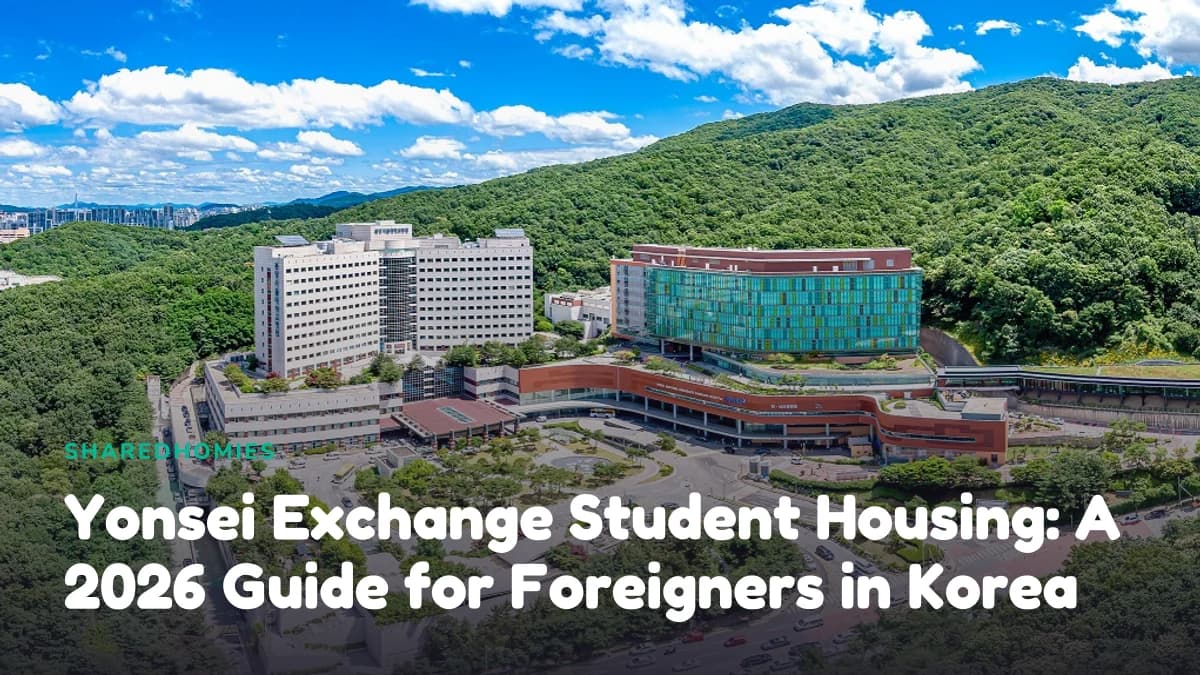
Yonsei Exchange Student Housing: A 2026 Guide for Foreigners in Korea
A step-by-step housing playbook for Yonsei exchange students: dorm odds, off-campus options near Sinchon, budgets, and a February 2027 arrival timeline.
11 min read