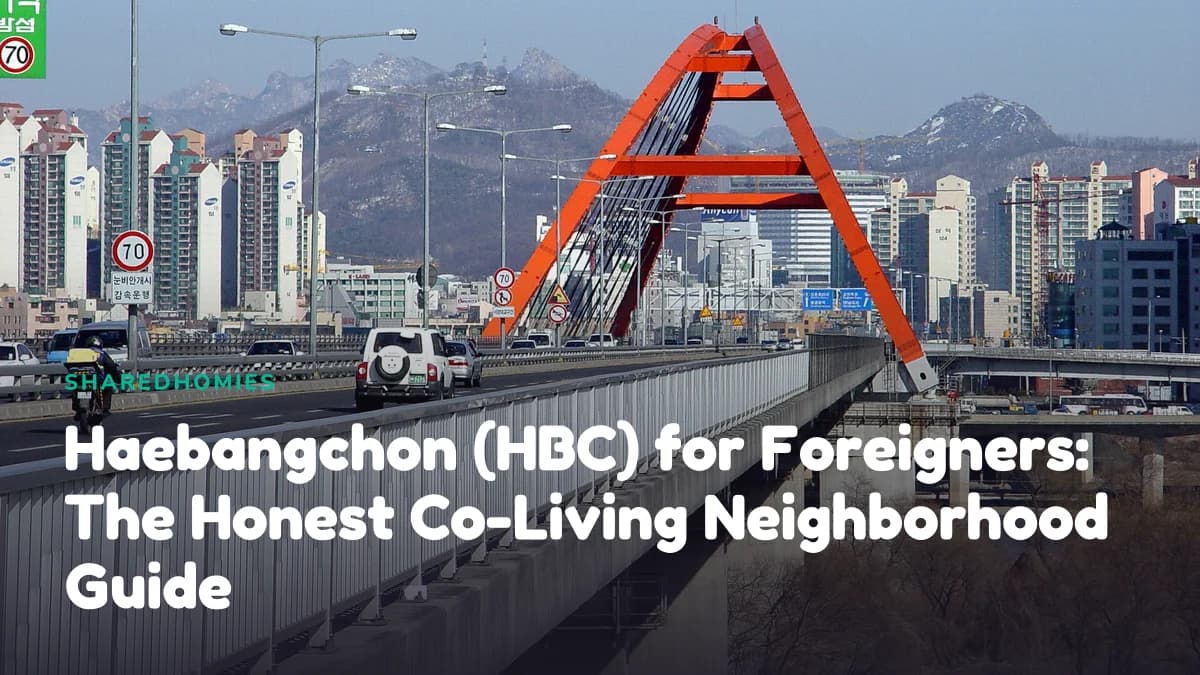
Haebangchon (HBC) for Foreigners: The Honest Co-Living Neighborhood Guide

- Haebangchon (HBC / 해방촌) sits on Namsan's south slope, one Line 6 stop from Itaewon and one hill walk from the calm of being slightly above the city.
- It's officially Yongsan-2-ga in Yongsan-gu; roughly 10% of residents are foreign — among the highest densities in Seoul.
- The neighborhood started as a 1945 refugee village, peaked as a knitting-factory district in the 70s–80s, hollowed out in the 90s, then refilled in the 2010s with artists and expats.
- Daily life centers on Sinheung-ro — a 15-minute uphill climb from Noksapyeong Station Exit 2 — and the rooftop view of N Seoul Tower at golden hour.
- The honest tradeoffs: hills, weekend bar noise on the lower strip, gentrification (40–50 business turnovers since 2019), and cold winter wind off the mountain.
- HBC is wrong if you commute to Gangnam, hate stairs, or want quiet weekends. It's right if you want foreigner-density without Itaewon's pace.
- Shared Homies operates 8 co-living houses across HBC — flexible monthly stays, no key money (refundable deposit of ₩1.2M or one month's rent, whichever is higher), ARC-ready paperwork on day one.
Most foreigners who pick Haebangchon over Itaewon make the choice for one reason: the hill. Walk fifteen minutes uphill from Noksapyeong Station Exit 2 and the city's noise drops off a cliff. By the time you reach the top of Sinheung-ro you're standing under N Seoul Tower, looking south across the Han River, and the bar strip you just climbed away from feels like a different city. That's HBC. This guide covers what the neighborhood actually looks like for foreigners considering it as a Seoul base — the daily rhythm, the honest tradeoffs, and where Shared Homies fits on the slope.
This is supporting content under Best Seoul Neighborhoods for Foreigners. If you're still narrowing down between Itaewon, Hongdae, Gangnam and the rest, start there. This piece assumes you've already short-listed HBC and want the deep version.
Haebangchon (해방촌) means "Liberation Village." The name is literal — the neighborhood formed in 1945 when North Korean refugees and returning citizens settled the south slope of Namsan on land vacated by a Japanese military shooting range. The U.S. Army nominally controlled the area post-liberation but its authority was thin, and the village built itself: narrow alleys, tight rowhouses, stairs everywhere.
Through the 1970s and 1980s, HBC ran on knitwear. Korea Times reporting puts the peak at roughly 30,000 residents and 200 active knitwear manufacturers producing for major markets and the jeans trade that filled Itaewon below. The 90s gutted that — large retail chains, factory migration, the usual story — and the population shrank to around 20,000 by 1990 and kept falling.
The current era started around 2006. Low rents drew artists who needed studio space, and the HBC Festival kicked off the same year — an independent music festival that runs twice yearly and is still the neighborhood's clearest cultural anchor. English teachers followed the artists. Then came the cafe wave, the international restaurant wave, and the current state: roughly 13,000 residents, about 10% foreign per Korea Times, with the highest concentration coming from the United States, Canada, the Philippines, Australia, New Zealand, South Africa, the UK, Nigeria, Russia and Ecuador.
That history shapes how the neighborhood actually feels. The bones are working-class refugee village. The skin is international indie cafe scene. The two don't always mesh, but they coexist closer than they do almost anywhere else in Seoul.
下一节:Where HBC sits on a map (and why that matters) ↓HBC is the south face of Namsan. N Seoul Tower is directly above you. Itaewon's main strip is one ridge to the east, downhill. Yongsan Station and the Han River are south. The U.S. Yongsan Garrison — most of it now decommissioned and being converted into a national park — sits below the neighborhood, which is a big reason the foreigner ecosystem grew here.
The official subway answer is Noksapyeong Station (Line 6), Exit 2. From the exit, Sinheung-ro climbs continuously uphill to Sinheung Market and the upper village — Visit Seoul officially clocks this at 15 minutes. Itaewon Station (also Line 6, one stop east) is the alternative, also 15 minutes uphill from a different angle. Both work; locals pick based on which side of the hill they live on.
For most addresses higher up the slope, the village bus matters more than the subway. Yongsan 02 and Yongsan 03 climb the hill with stops every few hundred meters and run frequently. If you're carrying groceries or it's late, the bus is the answer. All eight Shared Homies HBC houses sit within roughly 8–15 minutes of Noksapyeong Exit 2 — the main-strip cluster (Leaf, Heights, Pocket) is closest, while the upper-slope houses (Sky, Blossom) lean toward the longer end, and that's exactly when the village buses earn their keep.
下一节:What does daily life actually look like? ↓A typical week for a foreigner living in HBC settles into a recognizable pattern within a month:
Weekday mornings. Coffee from one of the cafes lining Sinheung-ro — there are dozens now, ranging from third-wave specialty roasters to the indie holdouts. The walk to Noksapyeong Station downhill is 10 minutes; same walk back up after work is 15. Subway to Itaewon is one stop; to Hongdae about 25 minutes (Line 6 → transfer at Hapjeong → Line 2 or walk); to Gangnam 45+ minutes with transfers (this is the commute tax for living north of the river).
Weekday evenings. Dinner is the easy part — HBC's food scene runs Mexican, Middle Eastern, Ethiopian, Japanese, French, vegan, and the full spectrum of Korean comfort food, frequently within the same block per Visit Seoul's neighborhood inventory. The eating-out cost is roughly Itaewon-adjacent: ₩12,000–25,000 for casual, ₩30,000+ for sit-down.
Weekends. The sunset rooftop ritual is real. Most HBC residents pick one — Le Montblanc's terrace, Nuldam Space, or someone's house roof — and watch the light change behind Namsan Tower. Saturday afternoons fill Sinheung Market with the brunch crowd. Saturday nights, the lower 500 meters of Sinheung-ro gets loud with the bar crowd; the upper village stays quiet.
The hike option. You're 10 minutes from the Namsan trailheads and 25 minutes on foot to the base of N Seoul Tower. Most HBC residents end up hiking Namsan within their first two weeks, then settle into the foot-of-the-mountain morning walk routine.
下一节:What does it actually cost? ↓Direct-landlord rent in HBC sits in the band most foreigners will recognize from the broader Itaewon/Yongsan market. Per the data we pulled together in the neighborhoods pillar, monthly wolse for a small officetel runs roughly ₩700,000–1,200,000 with ₩10M+ deposits — slightly cheaper than Itaewon proper, but with the HBC premium of "the hill walk to your door" baked in.
That number is moving though. Korea Times reported in August 2024 that landlord turnover is accelerating: aging owner-operators who held rents low through COVID are selling to new buyers who are pricing closer to market. The reporting cites 40 to 50 business turnovers along the lower 500 meters of Sinheung-ro since 2019, with longtime anchors like The Workshop, Hidden Cellar, and Phillies (which relocated after 26 years in the neighborhood) all closing or moving.
What this means for a foreigner today: HBC is still cheaper than Hannam, still cheaper than Apgujeong, still a reasonable mid-range Mapo-adjacent rent. But the gap to Itaewon proper has narrowed, and the "cheap artistic Seoul village" framing some older guides use is increasingly out of date.
Co-living in HBC sits in a parallel band. Shared Homies HBC rooms currently run ₩675,000–₩1,350,000/month depending on room size and house, with most rooms clustering around ₩900,000–₩1,000,000. No key money (refundable deposit of ₩1.2M or one month's rent, whichever is higher), no Korean guarantor, no two-year lock-in. Browse current SH availability for live numbers as rooms turn over.
下一节:The honest tradeoffs ↓Three things to know before signing anything in HBC:
The hills are not negotiable. Sinheung-ro climbs continuously. Side alleys are steeper. There is no flat HBC. If you have knee issues, hate stairs, or refuse to live where Coupang Rocket can't easily drive to your door, the neighborhood will grind on you. The flip side: HBC residents accidentally become the fittest foreigners in Seoul.
Bar noise on the lower strip. Friday and Saturday nights, the lower 500 meters of Sinheung-ro is the HBC bar scene. Bass carries. If your address is on or directly off that stretch, expect noise until 2–3am on weekends. The upper village, by contrast, is residential-quiet — the bar crowd doesn't climb the full hill.
Gentrification is changing the texture. The indie shops that gave HBC its character through the 2010s are thinning out. Some get replaced by chain franchises; many get replaced by the unmanned photo booths Korea Times specifically called out as the dominant new tenant on the lower strip. The upper village holds its character better, but the trend is clear.
Winter wind off the mountain. Namsan deflects wind down the HBC slope in January and February. The temperature gap between HBC and central Seoul is small but the wind chill is real. Bring a proper coat and good gloves; you'll use both.
Subway access is limited for hill addresses. Noksapyeong is 15 minutes downhill. That walk takes longer going up. Most foreigners adapt — bus, taxi when carrying things, walk when not — but if you're someone who treats "10 minute walk to the station" as table stakes, HBC won't always deliver.
下一节:Where Shared Homies operates in HBC ↓A few honest disqualifiers:
- You commute to Gangnam, Pangyo, or anywhere south of the river daily. The transfer-heavy 45–55 minute commute will burn you out. Pick a south-of-river neighborhood or somewhere on Line 9 instead.
- You have mobility issues or strongly dislike walking uphill. This isn't a "you'll adapt" situation. The hill is the neighborhood.
- You want quiet weekend mornings on a main street. The lower strip is loud; the upper village is fine, but verify the specific address.
- You want a quintessentially Korean cultural immersion experience. HBC is one of the most international neighborhoods in Korea. Daily life involves more English than Korean by default. If you came to Seoul specifically to be the only foreigner in your block, pick Sillim, Anam, or an outer-ward neighborhood.
- You want the polished premium Hannam aesthetic. HBC is rougher, indie-er, more wabi-sabi. Hannam-dong, one ridge over, is a different product entirely.
If you're weighing HBC against the obvious adjacent options:
vs. Itaewon. Itaewon is louder, flatter, busier, more transit-accessible, and slightly more expensive. HBC is quieter, hillier, more residential, more indie. If you want nightlife within stumbling distance, pick Itaewon. If you want to be ten minutes walk from nightlife but not in it, pick HBC.
vs. Hannam-dong. Hannam is premium, polished, more expensive, less foreigner-density in raw numbers, and skews older / corporate / family. HBC is rougher and younger. If you have a corporate housing budget and want the upscale embassy-row feel, Hannam. If you have a flexible budget and want indie, HBC.
vs. Yeonnam / Hongdae. Yeonnam and Hongdae are the western Mapo creative-class districts — flatter, café-dense, but further from any embassy infrastructure and a longer commute to most central Seoul destinations. HBC is more international-feeling; Yeonnam is more Korean-feeling. Pick on which texture you want.
For the full eight-neighborhood comparison with cost data and audience fit, see the best Seoul neighborhoods for foreigners pillar.
下一节:The bottom line ↓HBC works for foreigners who want the international density of Itaewon without Itaewon's pace, who don't mind a hill, who optimize for indie character over polish, and whose work or routine doesn't require daily Gangnam commuting. The neighborhood is changing — gentrification is real, indie shops are turning over — but the core identity (refugee village turned artist enclave turned international hill village) is holding.
If HBC sounds right and you want to trial it before committing to a 12-month Korean lease, browse Shared Homies' eight HBC houses or check current availability. All of them sit on the slope, all of them carry the HBC trade-off package, and all of them let you find out within a month whether the hill is the right hill for you.
Shared Homies operates 8 furnished co-living houses on the Haebangchon slope. Monthly billing, no key money (refundable deposit of ₩1.2M or one month's rent, whichever is higher), no guarantor, ARC-ready paperwork on day one. If HBC is your short-list, start with availability or browse all houses.
常见问题

A team of foreigners and Koreans operating shared homes across Seoul. We write what we learn from running a co-living business for international tenants.