Working Holiday in Korea vs Japan: Which Should Be Your Asia Home Base? (2026)

- Both Korea (H-1) and Japan offer working holiday visas for ages 18–30.
- Japan's program is larger and more open; popular Korea quotas are smaller and fill fast.
- Seoul costs roughly 20% less than Tokyo across rent, food, and transport.
- Korea's catch is the deposit (보증금) — co-living skips it with furnished, low-deposit rooms.
- Korea's Incheon hub makes it the cheaper launchpad for weekend trips across Asia.
For most travelers choosing between a working holiday in Korea or Japan, the honest answer is: Japan is easier to get into and a dream to travel within, but Korea is cheaper to live in, simpler to base yourself in, and a better launchpad for the rest of Asia. Both give you a working holiday visa for ages 18–30 with the right to work — 12 months standard, with Korea’s H-1 running up to 18–24 months for US, Canadian, and UK nationals. Japan's program is larger and more open; Korea's high-demand quotas are smaller and fill fast. Seoul runs about 20% cheaper than Tokyo. And if your real plan is to make one Asian capital your home base and explore outward, Korea's lower costs and Incheon flight network tilt the math its way. Here's the full breakdown.
Korea or Japan for a working holiday — what's the quick verdict?
| 🇰🇷 Korea (H-1) | 🇯🇵 Japan (Working Holiday) | |
|---|---|---|
| Visa length | 12 months standard (18 for US, up to 24 for Canada/UK) | Up to 12 months |
| Age | 18–30 (U.S. has a student/recent-grad route instead of a hard cap) | 18–30 (Iceland 18–26) |
| Getting in | Smaller quotas for popular countries; fill fast | Larger quotas; some uncapped |
| Cost of living | ~20% cheaper than Tokyo | Higher, especially transport |
| Finding work | English gigs cluster in a few neighborhoods | More flexible job market overall |
| Housing catch | Big deposit (보증금) on normal leases | Smaller deposits, but pricier rent |
| Asia home base | Cheaper to live + fly out of Incheon | Great to travel in, costlier to fly out |
| Best for | Budget-stretchers, Asia explorers, K-culture | Job-market flexibility, Japan devotees |
Both are excellent. The rest of this guide is about which is the better fit for your year — and the numbers behind each row.
How hard is each visa to get?
The eligibility bar is similar: you're 18–30, you apply from your home country, and you show proof of funds, a return ticket (or funds for one), health insurance, and a clean record. The real difference is supply — how many spots each country hands out.
Japan's program is bigger and, for several countries, uncapped. Korea's H-1 allocations for high-demand countries are smaller, and they can fill within weeks of opening.
| Country quota (annual) | 🇯🇵 Japan program | 🇰🇷 Korea program |
|---|---|---|
| United Kingdom | 6,000 (raised from 1,500) | — |
| Canada | 6,500 | — |
| United States | — | ~2,000 (historical) |
| Ireland | 800 | — |
| Austria | — | 300 |
| Australia / New Zealand | No cap | No cap (varies) |
Quotas are published per partner country and differ by country, so the table above pairs each nation with whichever program publishes a figure. Sources: Embassy of Japan in the UK, Korea MOFA — Seattle Consulate.
A few mechanics that matter once you're in:
- Korea (H-1): you can work up to 25 hours per week, entry type varies by nationality (single-entry for some passports, multiple-entry for the US, Canada, UK, and Hong Kong), and nationals of Japan, Hong Kong and France pay no visa fee. (Korea MOFA)
- Japan: side jobs are permitted except in entertainment, gambling, or nightlife venues, and as of October 2025 several nationalities — including South Koreans — can do the program twice in a lifetime. (Ministry of Foreign Affairs of Japan)
Demand is surging. The number of young Koreans taking working holiday visas to Australia, Canada and Japan jumped roughly eightfold — from about 4,250 in 2021 to 32,620 in 2024. (The Korea Times) Translation: popular quotas get more competitive every year — apply early.
Can you actually find work — and what will you earn?
Both countries have real work, but neither hands it to you. English-friendly gigs — tutoring, hospitality, cafés, camps, content work — cluster in foreigner-heavy areas, and speaking the local language widens your options dramatically. Without it, you compete for a smaller English-medium pool.
For reference, formal English teaching in Korea (a separate E-2 visa track, not the working holiday itself) pays roughly ₩1.5–3 million/month in public schools and ₩1.9–2.4 million/month in hagwons (학원). (Go Overseas) Working-holiday work tends to be more part-time and casual than these full contracts — keep what you do inside what the H-1's 25-hour rule allows.
The payoff, though, is real. As one couple who taught in Korea put it:
"Moving to Korea to teach English was one of the best life decisions we ever made." — Kim and Del Hogg, Going the Whole Hogg
If your goal is maximum job-market flexibility, Japan's broader economy gives you more directions to turn. If your goal is to earn enough to live well and travel, Korea's lower costs mean your won goes further — which brings us to money.
Is Seoul or Tokyo cheaper to live in?
Seoul wins on cost. Comparisons put it roughly 20% cheaper than Tokyo overall, with lower rent, a cheaper and more integrated subway, and slightly cheaper eating out. (Numbeo)
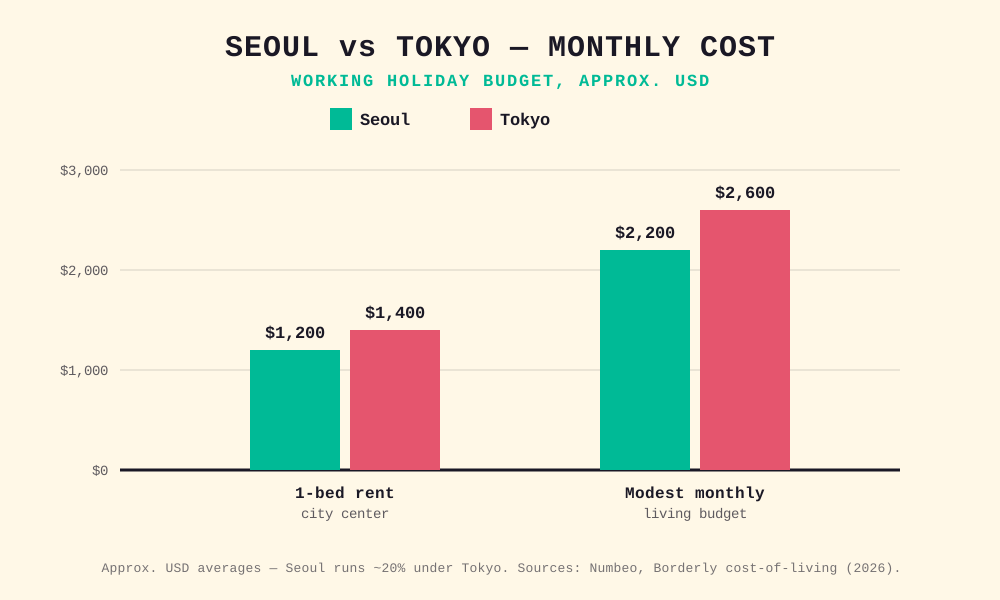
| Monthly cost (approx. USD) | 🇰🇷 Seoul | 🇯🇵 Tokyo |
|---|---|---|
| 1-bed apartment, city center | $1,200 | $1,400 |
| 1-bed apartment, outside center | $650 | higher |
| Modest monthly living budget | $1,700–2,800 | $2,000–3,200 |
| Mid-range restaurant meal | $9–14 | $10–15 |
| Cinema ticket | $10–12 | $15–18 |
| Utilities (small apartment) | $80–140 | $80–140 |
Sources: Numbeo, Borderly cost-of-living. Figures are approximate USD averages and move with exchange rates.
The gap isn't dramatic on any single line — it's that Seoul is a little cheaper on almost every line, and small differences compound across a 12-month stay.
What does your rent actually get you?
Here's the one place Korea trips people up. A standard Korean lease — wolse (월세) or jeonse (전세) — demands a large refundable deposit (보증금) and usually a Korean guarantor. For someone arriving on a one-year visa with no local credit history, both are genuine obstacles. It's the single most common housing shock for working holiday makers in Seoul.
The way around it is the same setup most of them actually use: furnished co-living and share houses, which run on a small deposit, include utilities and furniture, need no guarantor, and provide the address documentation you need for your ARC (외국인등록증). You trade a private full apartment for a private room plus shared kitchen and lounge — and shrink the deposit trap to a single refundable deposit (₩1.2M or one month's rent, whichever is higher). (Our guide to getting your deposit back and co-living vs other housing options go deeper.)
Tokyo flips the trade-off: smaller deposits, but you pay for it every month in higher rent. Either way, for a one-year stay, a furnished room you can book before you fly beats hunting for an unfurnished lease after you land.
Which is the better home base for exploring Asia?
This is where Korea pulls ahead for a specific kind of traveler — the one who wants a capital to live in and explore outward from.
Incheon International Airport is one of Asia's largest hubs, with cheap short-haul flights to Japan, Taiwan, Vietnam, Thailand, the Philippines and beyond. Pair that with Korea's lower cost of living, and more of what you earn survives to fund actual trips. You can make Seoul your base, work your 25 hours, and weekend-hop the region.
That's not theory. One teacher described what a Korea base made possible:
"With the money I saved teaching in South Korea, I was able to fly back home twice during the year due to family reasons. With the balance, I went backpacking through Asia for 4 months, hiked to Everest Base Camp." — Carryn, Torn Tackies Travel Blog
Japan is a phenomenal country to travel within — but it's costlier to live in and to fly out of for budget regional hops. If "home base for all of Asia" is the dream, Korea stretches the same money further.
Who should choose Korea, and who should choose Japan?
| If you are… | Choose | Why |
|---|---|---|
| On a tight budget | 🇰🇷 Korea | ~20% cheaper across the board |
| Planning to explore the rest of Asia | 🇰🇷 Korea | Incheon hub + lower costs = more trips |
| Worried about a small visa quota for your country | 🇯🇵 Japan | Larger, sometimes uncapped allocations |
| Wanting the widest range of casual jobs | 🇯🇵 Japan | Broader, more flexible job market |
| Drawn to K-culture, food, and nightlife | 🇰🇷 Korea | You'll be living inside it |
| Set on Japan specifically | 🇯🇵 Japan | The right reason is wanting Japan |
There's no wrong answer — only the one that fits your year. But if you're optimizing for money that lasts and a base to see the region, Korea is the pick.
Chose Korea? Here's how to land a room before you fly.
The hardest part of a Korean working holiday isn't the visa — it's arriving to no address, no furniture, and a deposit-and-guarantor wall. Shared Homies solves exactly that: furnished, foreigner-friendly co-living rooms in the neighborhoods working holiday makers actually want — Itaewon, Haebangchon, Hongdae — on a small deposit, no guarantor, ARC-ready paperwork included. And because booking a room from the other side of the world is nerve-wracking, we offer a live video walkthrough with the on-site manager before you commit a single won.
Start with the Working Holiday in Korea pillar guide for visa-to-move-in detail, then browse available rooms.
This article is practical guidance, not legal or financial advice. Visa quotas, fees, and costs change — confirm current details with the relevant embassy or consulate before you apply.
Frequently asked questions

F-4 visa holder operating co-living houses in Seoul since 2023. Writes about the practical reality of foreigner housing in Korea — what the friction actually costs, what it takes to live here long-term, and where the rental system trips up newcomers.
We reply within 24 hours · ★ 5.0 on Google Reviews
or browse the houses first →Related reading

Working Holiday Accommodation Seoul: A 2026 Guide for Foreigners in Korea
A step-by-step 2026 housing playbook for H-1 working holiday makers in Seoul: budgets, neighborhoods, contracts, and how to book before you land.
10 min read
Working Holiday in Korea: A 2026 Guide for Foreigners
A step-by-step 2026 guide to the H-1 working holiday visa in Korea: eligibility, application, arrival setup, housing, and job hunting.
6 min read
How to Find a Job in Korea Without Speaking Korean (2026 Guide)
Most foreigners in Korea want to stay longer than their visa allows — but the large majority of job postings are in Korean. Here are the realistic paths, the platforms that actually work, and what to do about your visa while you figure it out.
8 min read