The Expat's Guide to Co-Living in Seoul (2026): What It Is, What It Costs, and Where to Find It

- Co-living = private furnished room in a shared house, all-inclusive pricing, no Korean guarantor needed.
- Monthly cost: ₩650,000–1,400,000 depending on neighborhood and room size.
- Best neighborhoods for expats: Haebangchon, Hongdae, Mapo, Itaewon, Sinchon.
- No ARC, no Korean bank account, and no deposit needed to move in.
- Provides ARC-ready address documentation — the single biggest advantage over gosiwon and hotels.
For most expats arriving in Seoul, co-living is the answer to the first big question: where do I live while I figure everything out? It solves the guarantor problem, the ARC documentation problem, the furnishing problem, and the "I don't speak Korean" problem — all in one monthly payment. This guide explains what co-living in Seoul actually looks like, what it costs, which neighborhoods work best for expats, and how to find a place without getting burned.
What co-living in Seoul actually is
Co-living in Seoul means renting a private furnished room inside a shared residential property. You get your own room with a lock. You share the kitchen, living room, bathrooms, and laundry with the other residents — typically 3–12 people, usually a mix of nationalities. One monthly payment covers rent, utilities, Wi-Fi, and often cleaning.
The defining feature that matters for expats: co-living operators handle everything on the Korean side. Utility contracts, building management, maintenance requests, internet setup — these are in Korean and the operator absorbs them. You deal with the operator in English and they deal with Korea in Korean.
This is fundamentally different from renting a direct apartment in Seoul, where you negotiate with a Korean landlord, set up utilities in Korean, and manage building relationships in Korean.
What co-living costs in Seoul (2026)
| Neighborhood | Private room (monthly, all-inclusive) | Typical room size |
|---|---|---|
| Haebangchon / HBC | ₩650,000–850,000 | 10–14㎡ |
| Hongjae / Muakjae | ₩650,000–850,000 | 10–16㎡ |
| Hongdae / Sinchon | ₩750,000–1,000,000 | 10–16㎡ |
| Mapo (Hapjeong/Mangwon) | ₩700,000–950,000 | 10–18㎡ |
| Kyunglidan / Itaewon | ₩800,000–1,100,000 | 12–18㎡ |
| Gangnam / Seocho | ₩950,000–1,400,000 | 12–20㎡ |
All-inclusive means: Wi-Fi, electricity, gas, water, and building management fees. Some operators include weekly cleaning and shared kitchen supplies.
What you don't pay separately: deposit (or a small refundable deposit of ₩200,000–500,000 vs ₩5,000,000–20,000,000 for direct rentals), furnishing costs, utility setup, internet contract, appliance purchases.
Who co-living in Seoul is for
Co-living is the right choice if any of these describe you:
- Newly arrived with no ARC, no Korean bank account, no local phone number yet
- Staying 1–18 months and don't want to tie up capital in a multi-million won deposit
- Relocating from abroad and want to see the space before you commit — video walkthroughs are standard with most operators
- Exchange or international student who needs an address for university enrollment and ARC application
- Digital nomad who wants a furnished, internet-ready space without a long-term lease
- Working holiday visa holder planning to travel around Korea between stays in Seoul
Co-living is not the right choice if you're staying 2+ years in the same neighborhood and have the capital and Korean language skills to manage a direct lease — at that point the economics favor direct wolse.
The ARC documentation advantage
This is the detail that changes the math for most expats who compare co-living to gosiwon.
To apply for your ARC (Alien Registration Card) at immigration, you need a residential address and the supporting document proving you live there. Gosiwon and hotels operate under hospitality (숙박업) licenses — they generally cannot provide the 거주/숙소제공 확인서 form that immigration requires for ARC applications.
Co-living operators with residential rental (임대) licenses can provide this form, plus a copy of their lease and operator ID — the full packet the immigration office expects. Without this, you go to your ARC appointment empty-handed and get sent away.
If getting your ARC is on your agenda at any point, co-living is not just a housing option — it's the bureaucratic enabler for everything that follows: Korean bank account, NHIS healthcare, postpaid SIM, eventual direct lease eligibility.
Before booking any co-living space, confirm explicitly: "Do you provide the 거주/숙소제공 확인서 and full address documentation for ARC applications?" If the answer is unclear, move on.
Best neighborhoods for expat co-living in Seoul
Haebangchon (HBC) — the expat classic
Located in Yongsan-gu near Namsan Mountain and Itaewon, HBC is the most internationally mixed neighborhood in Seoul. English-friendly restaurants, international grocery options, independent cafes, and a community of long-term expats who know the Korea bureaucracy ropes. Subway: Noksapyeong (line 6), 20 minutes to Gangnam, 30 minutes to Hongdae.
Hongjae / Muakjae — quieter, central
Between Mapo and Seodaemun districts, this cluster offers some of the best value in central Seoul with a quieter neighborhood feel than HBC or Hongdae. Close to Yonsei University and Ewha Womans University for students.
Hongdae / Sinchon — student and creative
If you're attending Yonsei, Sogang, or Hongik University, or if you want nightlife, music venues, and independent shops on your doorstep, Hongdae-Sinchon is the natural base. Higher energy, slightly higher prices, younger demographic.
Kyunglidan — boutique and walkable
Between HBC and Itaewon, Kyunglidan is a narrower street of specialty coffee shops, international restaurants, and independent stores. Walking distance to Noksapyeong station and the Namsan hiking trails.
How to find a co-living room in Seoul from abroad
The biggest practical challenge for incoming expats: how do you book housing when you can't visit in person?
The two things that matter:
- Video walkthroughs — ask every operator whether they'll do a live video call showing the actual room, common areas, and neighborhood streets. Operators who refuse or only send photos should be treated with skepticism.
- Booking confirmation via email — never send a deposit without a written booking confirmation that specifies the room, move-in date, monthly price, and cancellation policy.
Red flags:
- Operator asks for full deposit via wire transfer with no contract
- No English communication before booking
- Photos look like stock images (reverse image search them)
- No address or video call option before deposit
For a broader overview of the Seoul rental system and what to expect at each stage of your Korea stay, see How to Rent in Seoul as a Foreigner.
The video walkthrough advantage for overseas bookers
One practical note that rarely gets mentioned: the operators who do live video walkthroughs before booking are almost always the operators who will actually support you after move-in. A house tour takes 15 minutes and costs the operator nothing — an operator who won't spend that 15 minutes with a prospective tenant is showing you their customer service culture before you sign anything.
If you're relocating from abroad, a live walkthrough also lets you ask specific questions: is the neighborhood safe at night? Is the kitchen shared with how many people? Is the hot water reliable? What's the noise situation on weekends? These are the things photos never show.
SharedHomies operates 17 co-living houses across central Seoul — Haebangchon, Hongjae, Muakjae, and Kyunglidan. All rooms are furnished, all-inclusive, no guarantor, English support from inquiry through ARC documentation. We do live video walkthroughs for every overseas inquiry. Browse available rooms.
Frequently asked questions

F-4 visa holder operating co-living houses in Seoul since 2023. Writes about the practical reality of foreigner housing in Korea — what the friction actually costs, what it takes to live here long-term, and where the rental system trips up newcomers.
Related reading
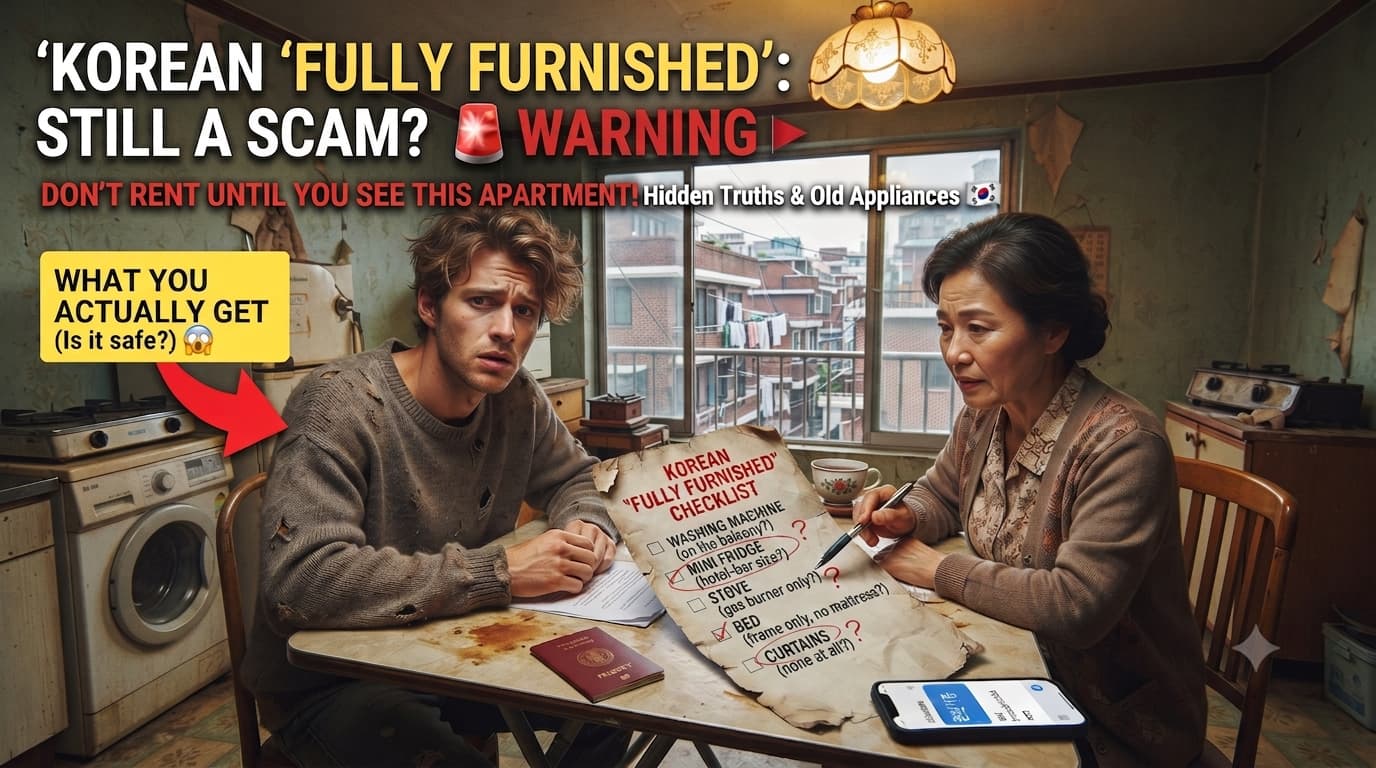
What \"Fully Furnished\" Actually Means in Korea — 풀옵션, Category by Category
In Korean listings, \"fully furnished\" (풀옵션) can mean a fridge and a washing machine — or a genuine turnkey home. Here's the category-by-category breakdown, what each tier usually includes, and what filling the gaps costs.
5 min read
The Hidden Tax of DIY Rentals in Seoul: The Full Cost Foreigners Actually Pay
The rent on a direct Seoul lease is the visible half of the bill. Here's the full accounting — deposit opportunity cost, furnishing, contracts, utility setup, and 20–40 hours of Korean-language bureaucracy — with the numbers side by side.
5 min read
Korean Lease Contract Red Flags Every Foreigner Should Know — With Example Clauses
Nine red flags in Korean rental contracts that cost foreigners deposits: mismatched owner names, banned move-in reports, blanket repair clauses, and the special terms (특약) that quietly override everything — with the actual contract language to watch for.
6 min read
How to Get Your Rental Deposit Back in Korea (Even If the Landlord Won't Pay)
Korean deposits are refundable by law — but the law only works if you follow the sequence: written notice, documented handover, certified letter, lease registration order, then mediation or court. Here's the full playbook for foreigners.
6 min read