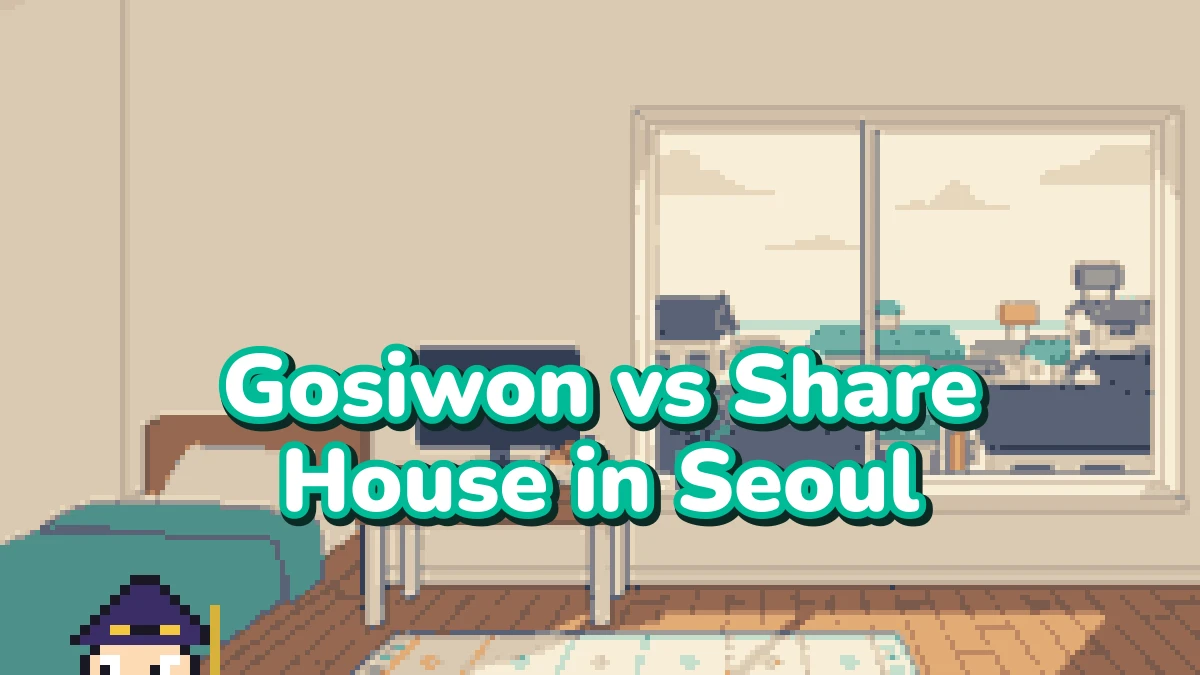
Colocation vs gosiwon à Séoul : lequel vous convient ?

- Gosiwon : ₩300K–550K/mois, chambre de 4–7 m², salle de bain partagée, pas de documents ARC, pas de vie communautaire.
- Colocation : ₩650K–1,4M/mois, chambre privée de 10–20 m², cuisine/salon partagés, prêt pour l'ARC.
- Le gosiwon ne gagne que sur le prix. La colocation gagne sur la taille, le confort de vie et l'utilité administrative.
- Si vous avez besoin d'une adresse pour votre ARC — choisissez une colocation. Le gosiwon ne peut pas fournir les papiers.
- Si vous restez moins de 2 mois et que le coût est tout, le gosiwon convient.
Les deux options qui dominent le segment économique du marché du logement pour étrangers à Séoul sont le gosiwon et la colocation. Les deux sont moins chers qu'une location wolse en direct. Les deux acceptent les étrangers sans l'ensemble complet des papiers de location coréens. Mais ils répondent à des situations très différentes, et le mauvais choix peut vouloir dire passer 6 mois dans un espace de la taille d'un dressing, ou dépenser deux fois plus que nécessaire.
Voici la comparaison honnête.
La différence fondamentale : la taille de la chambre
C'est le chiffre qui compte avant tout le reste.
Une chambre de gosiwon à Séoul fait 4 à 7 mètres carrés. C'est à peu près l'empreinte au sol d'une grande salle de bain. Elle contient un lit simple, un petit bureau, un mini-réfrigérateur, et rien d'autre. Le mur et la porte vous séparent d'un couloir avec des salles de bain partagées. Il n'y a presque jamais de lumière naturelle. C'est fonctionnel — vous pouvez y dormir, y étudier, y exister — mais ce n'est pas confortable au-delà de quelques semaines.
Une chambre privée en colocation à Séoul fait 10 à 20 mètres carrés — une vraie chambre. Elle contient un vrai lit, une armoire, un bureau, et parfois un petit coin salon. Les espaces communs (cuisine, salon, parfois un toit-terrasse ou une cour) ajoutent un espace de vie appréciable. Vous pouvez recevoir un ami, cuisiner un vrai repas et sortir le matin sans avoir l'impression d'être sorti d'un box de stockage.
Si vous restez plus de 60 jours à Séoul, cette différence de taille compte davantage que la différence de prix.
Comparaison complète des coûts
| Critère | Gosiwon | Colocation / Co-living |
|---|---|---|
| Chambre mensuelle | ₩300 000–550 000 | ₩650 000–1 400 000 |
| Charges | Souvent en sus (₩50K–100K/mois) | Incluses |
| Internet | En sus (₩30K–50K/mois) | Inclus |
| Ménage | À votre charge | Souvent inclus (hebdo/bimensuel) |
| Dépôt | ₩100 000–500 000 | ₩200 000–500 000 (faible ou nul) |
| Ameublement à prévoir | Non (minimal inclus) | Non (entièrement meublé) |
| Coût mensuel réel tout compris | ₩380 000–700 000 | ₩650 000–1 400 000 |
L'écart se réduit une fois qu'on ajoute les charges et Internet au gosiwon. Pour un séjour de 6 mois, la différence de coût total entre un gosiwon économique (₩400 000/mois tout compris) et une colocation économique (₩700 000/mois tout compris) est de ₩1 800 000 — environ 1 300 USD. C'est un vrai chiffre, et pour certains voyageurs, cela fait du gosiwon le bon choix. Mais pour la plupart des personnes qui restent 3 mois ou plus, ₩300 000/mois de plus pour un espace vivable, une vraie cuisine et des gens à qui parler en vaut la peine.
La différence de documents ARC
C'est le facteur décisif pour la plupart des expats qui prévoient un vrai séjour en Corée.
Pour demander votre ARC (carte de résident étranger / 외국인등록증) au bureau de l'immigration coréen, vous devez prouver que vous disposez d'une adresse résidentielle. Le document requis est soit :
- Un contrat de location résidentielle (임대차계약서) à votre nom, soit
- Une attestation de résidence (거주/숙소제공 확인서) de votre opérateur, adossée à sa licence commerciale résidentielle
Un gosiwon ne peut fournir ni l'un ni l'autre document dans la plupart des cas. Ils opèrent sous une licence d'hébergement (숙박업), pas une licence de location résidentielle. Lorsque vous vous présentez à votre rendez-vous ARC avec une confirmation de réservation de gosiwon, l'agent d'immigration la refuse généralement et demande un contrat résidentiel.
Les colocations disposant d'une licence de location résidentielle peuvent fournir le dossier complet. Un bon opérateur vous remettra : l'attestation signée, une copie de son bail ou de son titre de propriété, et une copie de sa pièce d'identité — exactement ce dont l'immigration a besoin. Confirmez-le explicitement avant de réserver.
L'ARC débloque tout le reste en Corée : compte bancaire coréen complet, inscription à l'assurance maladie NHIS, forfait mobile avec abonnement, éligibilité à la location directe. Sans lui, vous fonctionnez en mode restreint pendant tout votre séjour. Pour la plupart des expats qui prévoient de rester en Corée plus de 90 jours, l'ARC n'est pas optionnel — ce qui veut dire que le type de logement qui vous permet de l'obtenir ne l'est pas non plus.
Qui devrait choisir un gosiwon
Le gosiwon est la bonne réponse quand :
- Votre séjour dure moins de 60 jours et vous n'avez pas besoin de documents ARC
- Le budget est la contrainte absolue et l'écart de prix justifie le compromis sur la taille
- Vous êtes entre deux logements — vous avez quitté un endroit, en attendez un autre, il vous faut 2 semaines quelque part où dormir
- Vous voyagez souvent et êtes rarement chez vous — le gosiwon comme base où vous dormez plutôt que vivez
Ce n'est pas la bonne réponse pour un expat qui prévoit de vivre à Séoul 6 à 18 mois et qui a besoin d'un ARC, d'une vie sociale et d'une cuisine où l'on peut vraiment cuisiner.
Qui devrait choisir une colocation
La colocation / le co-living est la bonne réponse quand :
- Vous restez 1 à 18 mois et voulez une vraie chambre
- Vous avez besoin de documents ARC — cela seul est décisif pour la plupart des expats
- Vous vous installez depuis l'étranger et voulez une gestion anglophone, des visites vidéo et une communauté d'autres internationaux dès votre arrivée
- Vous êtes étudiant en échange ou international et avez besoin d'un justificatif d'adresse pour votre inscription universitaire
- Vous voulez une communauté — des repas dans la cuisine, des gens à qui demander conseil sur les quartiers, d'autres expats qui ont résolu les mêmes problèmes administratifs que ceux que vous allez affronter
La checklist pratique avant de réserver l'un ou l'autre
Pour un gosiwon :
- Les charges sont-elles incluses ou en sus ?
- Internet est-il inclus ou faut-il un contrat séparé ?
- Comment sont organisées les salles de bain (partagées par étage ou par chambre) ?
- La chambre a-t-elle une fenêtre ?
- Quelle est la durée minimale de séjour ?
Pour une colocation :
- L'opérateur fournit-il des documents d'adresse prêts pour l'ARC ? (Demandez-le explicitement)
- Est-ce tout compris (charges, Wi-Fi, ménage) ?
- Quelle est la durée minimale de séjour ? Quel est le préavis ?
- Pouvez-vous faire une visite vidéo avant de réserver ?
- Combien de personnes partagent la cuisine et les salles de bain ?
Pour plus de contexte sur la façon dont les colocations se comparent aux appartements en direct, aux gosiwon et aux autres types de logement à Séoul sur des horizons de 6 et 12 mois, voir le comparatif complet des coûts du logement à Séoul.
SharedHomies gère des colocations dans les quartiers centraux d'expats de Séoul — Haebangchon, Hongjae, Muakjae et Kyunglidan. Chambres privées meublées, tarif tout compris, documents ARC fournis, support en anglais du début à la fin. Voir les chambres disponibles.
Questions fréquentes

F-4 visa holder operating co-living houses in Seoul since 2023. Writes about the practical reality of foreigner housing in Korea — what the friction actually costs, what it takes to live here long-term, and where the rental system trips up newcomers.
Réponse sous 24 heures · ★ 5,0 sur Google Reviews
ou parcourez d'abord les maisons →À lire ensuite
Korea Deposit Jeonse Explained: A 2026 Guide for Foreigners in Korea
A step-by-step 2026 guide to Korean rental deposits — jeonse, wolse key money, and the alternatives — written for foreigners who want their money back.
12 min de lecture
Korea University Exchange Student Housing: A 2026 Guide for Foreigners in Korea
A step-by-step housing playbook for exchange students at Korea University — dorm lottery odds, Anam neighborhood options, contract checks, and February 2027 move-in planning.
12 min de lecture
Yonsei Exchange Student Housing: A 2026 Guide for Foreigners in Korea
A step-by-step housing playbook for Yonsei exchange students: dorm odds, off-campus options near Sinchon, budgets, and a February 2027 arrival timeline.
11 min de lecture
How I'd Find Safe Female Student Housing in Seoul in 7 Steps (Without Getting Scammed)
A step-by-step playbook for international female students choosing safe, affordable Seoul housing — from visa docs to move-in, with real cost benchmarks.
8 min de lecture