
How to Throw Out Trash in Korea: The Complete Newcomer's Guide (2026)

- General waste goes in your district's white 종량제 bag, sold at every convenience store.
- A 20 L bag is ₩490 in most of Seoul; food waste has its own yellow bags.
- Recycling goes out clean, in a clear bag, sorted by material.
- Put it all in front of your house after 6 pm, never on Saturday.
- Wrong bag, wrong time or wrong place is a ₩100,000 fine, and the alley has CCTV.
Trash in Korea works like this: general waste goes in a white bag printed with your district's name, bought at any convenience store; food waste goes in a small yellow bag from the same counter; recycling goes out clean and sorted in a clear bag; and all of it sits in front of your house after 6 pm on a collection day. The bag is the fee. Get the bag, the sort or the timing wrong and the district office can fine you ₩100,000 on the first offence, and the alley you did it in probably has a camera. This guide walks through every step, with the exact words to say at the counter, the sizes and prices, where the orange bucket fits in, and what to do with a mattress or a bag of old clothes.
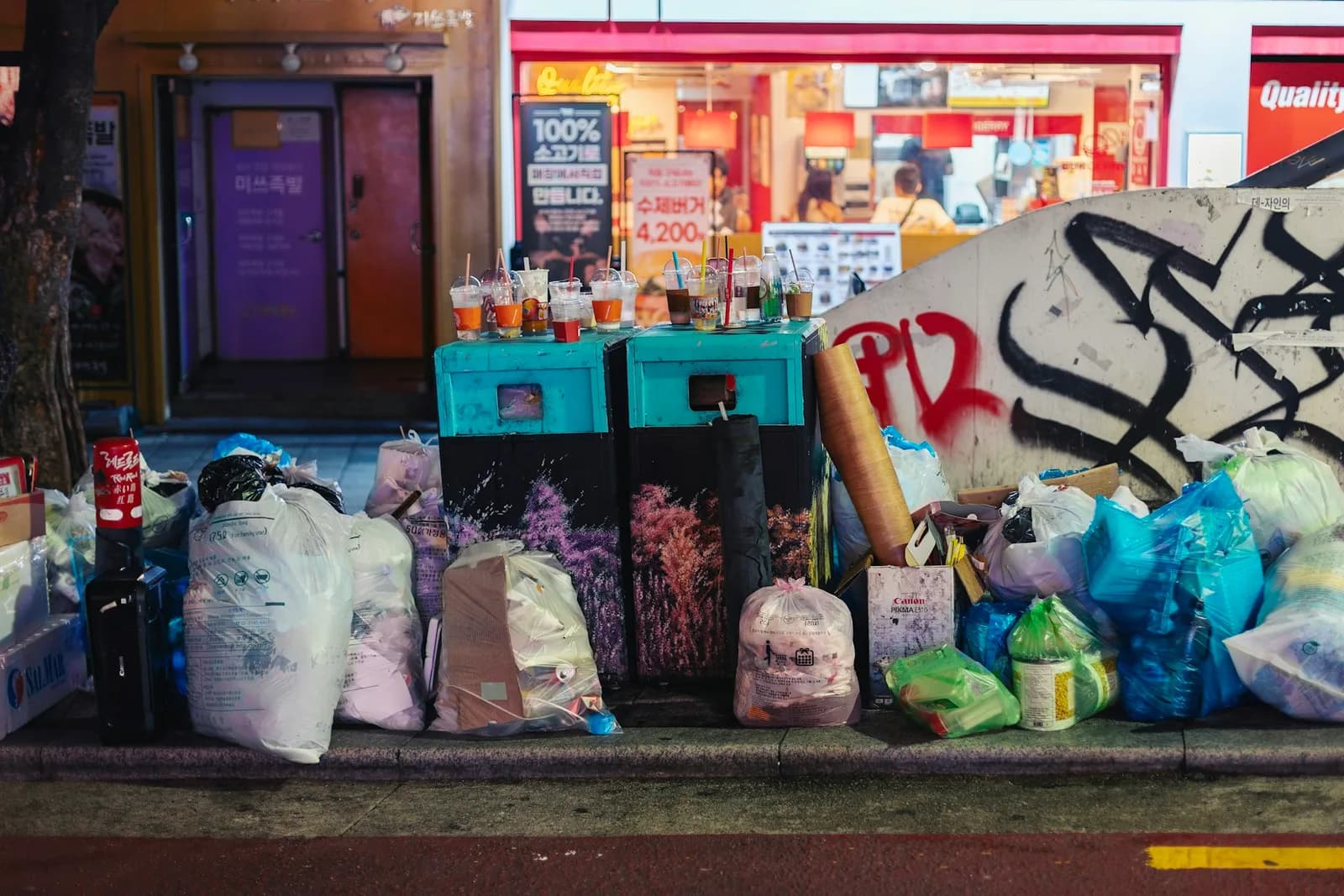
A Mapo-gu kerb near Hongik University Station on a collection night: white 종량제 bags, clear and blue recycling bags, cardboard folded flat. Photo: realfish / Unsplash.
What are the three streams every home in Korea sorts into?
Korea's household waste system has run on volume-based fees since 1995. You do not pay a flat collection charge; you pay each time you buy an official bag, and the district only collects waste that is in its own bag. Recycling is free. Food waste is metered separately because it is processed into feed and compost, not burned.
| Stream | Korean | What it goes in | What it costs |
|---|---|---|---|
| General waste | 일반쓰레기 | White district bag (종량제 봉투) | The bag price, about ₩490 per 20 L in Seoul |
| Food waste | 음식물쓰레기 | Yellow food-waste bag, placed in the orange bucket outside | The bag price, ₩100 to ₩1,000 by size |
| Recycling | 재활용품 | Clear bag or loose, sorted by material | Free |
| Large items | 대형폐기물 | A paid sticker or online declaration, then the kerb | ₩2,000 to ₩30,000 by item |
The whole system rests on one habit: sort at the moment you throw something away, not on collection night. Most Korean kitchens have a small lidded bin for food scraps, a white bag hanging somewhere, and a corner where clean bottles and cardboard wait for the weekly trip downstairs.
Which bag do you need, and what does it cost?
There are two bags to know. The white one is for general waste and comes in sizes from 3 to 75 litres. The yellow one is for food waste and comes in 1 to 10 litres. Both are sold in packs, and both are only valid in the district that printed them.
Prices are set by each district office. The Gangdong-gu price list is typical for Seoul and matches what you will pay in Yongsan, Mapo or Gwanak within a few won:
| Size | General waste (white) | Food waste (yellow) | Who it suits |
|---|---|---|---|
| 1 L | – | ₩100 | A single cook, one or two days of scraps |
| 2 L | – | ₩190 | One person, a few days |
| 3 L | ₩90 | ₩300 | Two people, or a week of frozen scraps |
| 5 L | ₩130 | ₩500 | A shared kitchen |
| 10 L | ₩250 | ₩1,000 | A single room, one week of general waste |
| 20 L | ₩490 | – | The everyday bag for most households |
| 30 L | ₩740 | – | A couple or a busy shared house |
| 50 L | ₩1,250 | – | Move-out week, large households |
| 75 L | ₩1,880 | – | Businesses, big clear-outs |
Seoul's 20-litre price has been ₩490 since 2017, but that is changing. From 1 January 2026 the capital region can no longer send bagged household waste straight to landfill; it has to be incinerated first, and Seoul's own incinerators only handle about 70 percent of the city's daily 3,200 tonnes, so the rest goes to private plants at ₩181,000 a tonne against ₩131,000 at public ones, according to a January 2026 report in the Financial News. Expect the bag price to rise; the district websites above always show the current figure.
The right size for a share-house room is the 10 L or 20 L white bag and the 2 L or 3 L yellow bag. Half-empty 50 L bags are a waste of money, and some collectors leave an under-filled bag behind.
How do you buy the bags at the convenience store?
Any GS25, CU, 7-Eleven or emart24 sells them, along with most supermarkets. Two things trip newcomers up: the bags are kept behind the counter, not on a shelf, and the store only stocks bags for the district it stands in. Buy near home and you cannot get the district wrong.
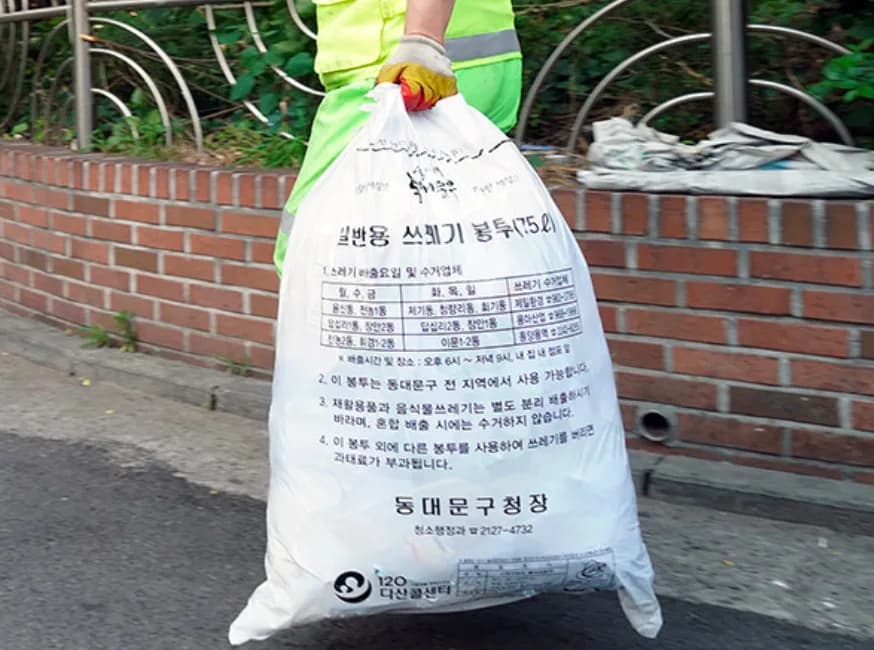
The white bag, up close. Every district prints its own: this Dongdaemun-gu 75 L bag lists the collection days by neighbourhood, the evening window, and the warning that trash in any other bag is fined.
At the counter, say:
- 종량제 봉투 이십 리터 하나 주세요. Jongnyangje bongtu isip liteo hana juseyo. One 20-litre general waste bag, please. Bags come in packs of ten or twenty; "하나" gets you one pack.
- 십 리터 있어요? Sip liteo isseoyo? Do you have 10-litre? Swap the number: 십 (10), 이십 (20), 삼십 (30), 오십 (50).
- 음식물 쓰레기 봉투 삼 리터 주세요. Eumsingmul sseuregi bongtu sam liteo juseyo. Food waste bags, 3-litre, please. Sizes: 일 (1), 이 (2), 삼 (3), 오 (5).
- 재활용 봉투 있어요? Jaehwaryong bongtu isseoyo? Do you have recycling bags? Some stores sell clear bags for recycling; any clear bag will do.
If speaking feels like too much, show the Korean on your phone. The cashier does this transaction a dozen times a shift, no ID needed, cards accepted. A pack of ten 20 L bags is under ₩5,000 and lasts a single person two to three months.
What goes in the white general waste bag?
Everything that is not clean recycling, not edible food waste and not big enough for a sticker. The test is contamination: if it would spoil a batch of recycling or jam a food-waste plant, it goes in the white bag.
| Goes in the white bag | Does not |
|---|---|
| Tissues, wet wipes, paper towels, nappies, sanitary products | Clean cardboard and paper (recycling) |
| Bones, shells, eggshells, fruit stones, tea bags, coffee grounds | Peels, leftovers, rice, bread (food waste) |
| Food-stained plastic, cup-noodle bowls, greasy pizza box lining | Rinsed plastic containers and PET bottles (recycling) |
| Broken glass and ceramics, wrapped in newspaper and marked 깨진 유리 | Intact bottles and jars (recycling) |
| Receipts (thermal paper), photos, wallpaper, laminated paper | Newspapers, magazines, books (recycling) |
| Toothbrushes, pens, hangers, toys, mixed-material items | Cans and clean foil trays (recycling) |
| Cigarette butts, vacuum dust, cat litter, cooking-oil-soaked paper | Clean styrofoam packaging (its own pile) |
Tie the bag at the top. Collectors reject bags that are open, torn or overstuffed past the tie line.
How do you sort recycling so it actually gets collected?
Recycling is free, and it is checked. Contaminated or mis-sorted recycling is left on the kerb with a sticker on it, and the building gets a warning. Thirty seconds of rinsing is what keeps it free.
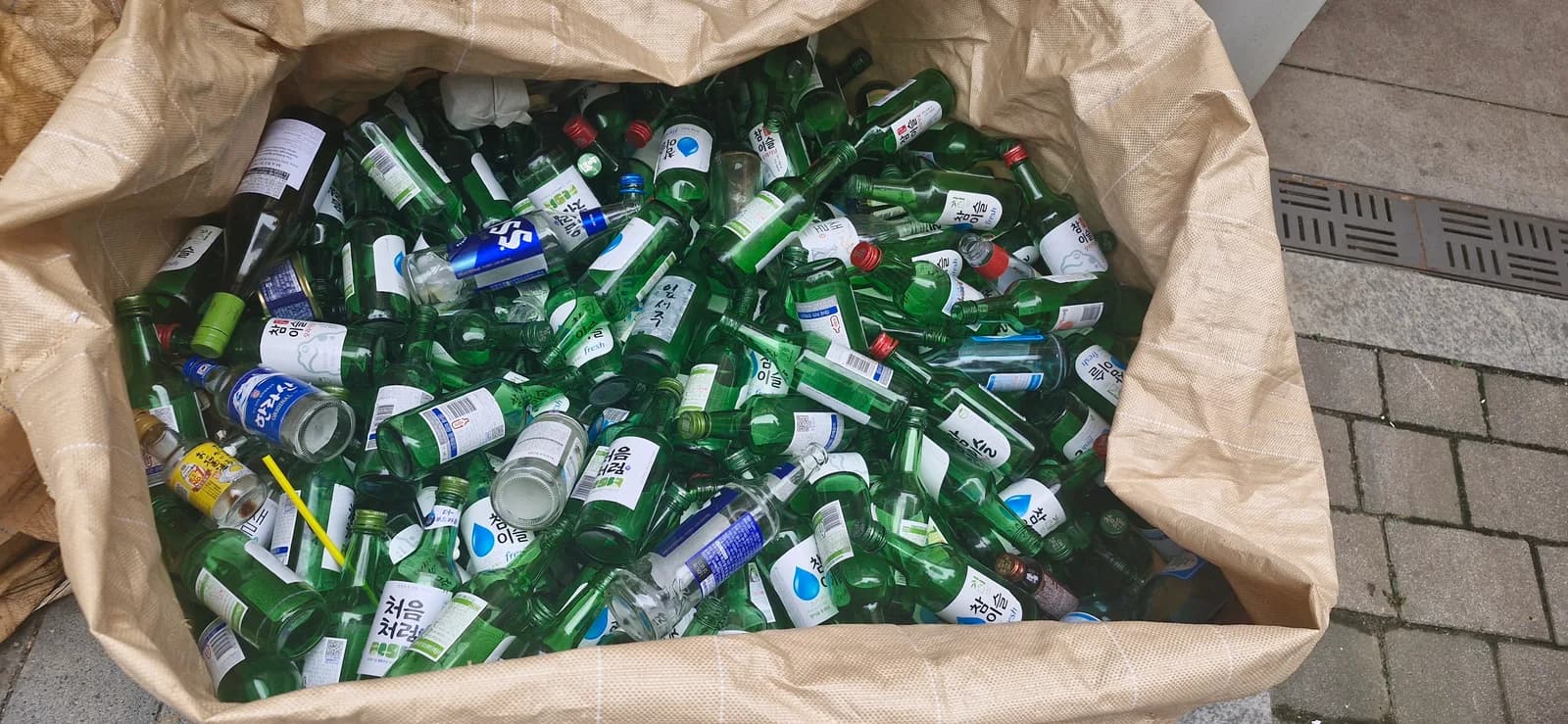
Glass goes out whole and rinsed, caps off. Soju and beer bottles also carry a ₩100 to ₩130 deposit you can claim back at a supermarket. Photo: Piotrus, CC BY-SA 4.0.
In an apartment complex there is a recycling station in the car park with a labelled bin for each material. In a villa or house, which is where most share houses are, you sort into clear bags and put them out with the general waste, or on the district's recycling day. Yongsan-gu's rules say recyclables go out "in a transparent bag", and that colourless PET bottles from houses go out separately on Thursdays.
- Paper and cardboard (종이류): flatten boxes, strip the tape and the delivery label, keep dry, tie with string. Milk and juice cartons are a separate paper-pack stream (종이팩): rinse, flatten, and keep them out of the cardboard.
- Transparent PET bottles (투명 페트병): water and soft-drink bottles go in their own bag. Empty, peel off the label, crush flat, put the cap back on. This has been mandatory for houses and villas since 25 December 2021, a year after apartments, under the Ministry of Environment rule. Coloured PET and other plastics go in the general plastics bag.
- Other plastics (플라스틱): rinsed containers, tubs and bottles. Remove pumps and metal parts. Toys, pens and anything made of mixed materials are general waste.
- Vinyl and film (비닐): snack bags, noodle wrappers, shopping bags, bubble wrap, clean. Collect them in one clear bag of their own. Dirty vinyl is general waste.
- Glass (유리병): whole bottles and jars, rinsed, caps off. Never break glass to save space.
- Cans (캔류): rinsed. Aerosols and butane canisters must be completely empty; pierce them outdoors first.
- Styrofoam (스티로폼): only clean white packaging foam, tape and stickers removed, kept in its own clear bag or stacked. Stained cup-noodle bowls and fruit netting are general waste.
If you are not sure, the Ministry of Environment's app 내 손안의 분리배출 ("recycling in my hand") answers item by item, and Seoul's Dasan call centre on 120 has English support.
How do you handle food waste without the smell?
Food waste is the stream newcomers hate, and the freezer is the answer. Keep a lidded tub or a zip bag on a freezer shelf, drop scraps in as you cook, and once a week tip the frozen block into a yellow bag. Nothing rots, nothing smells, no fruit flies, and the bag weighs less because it is not sitting in liquid. This is the single most useful housekeeping habit you can pick up in Korea, and it is what keeps a shared kitchen bearable in August.
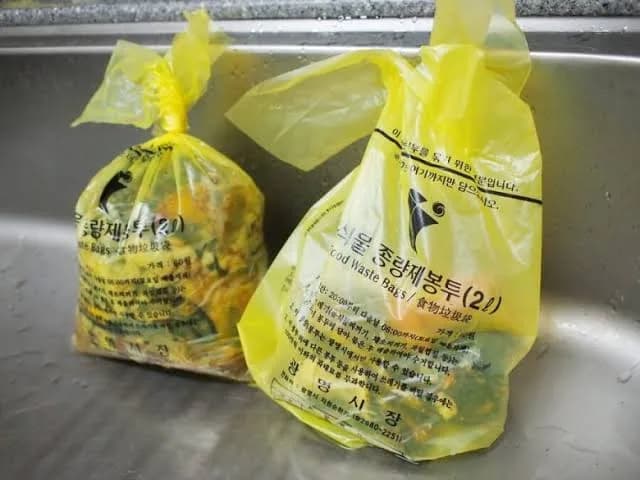
The yellow bag, 2-litre size. It is printed with the district name and the evening window, and it is the only bag the food-waste truck takes.
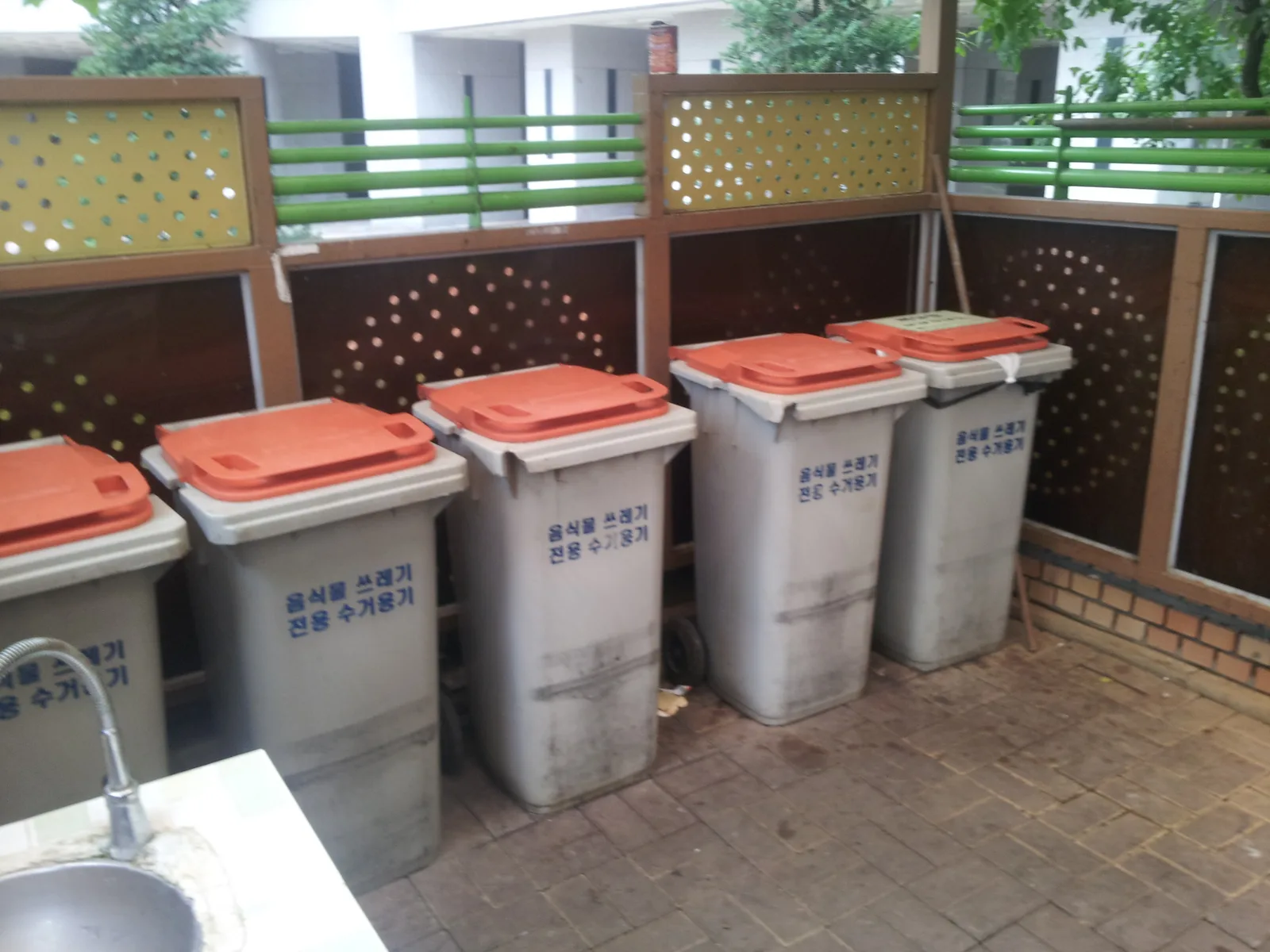
Apartment complexes pool food waste in lidded bins like these; villas and houses use a small orange bucket by the door instead. Photo: revi, CC BY 2.0 KR.
How the bag reaches the truck depends on where you live:
- Villa, house or share house: food waste goes in the yellow bag, tied, and the bag goes into the small orange food-waste container (음식물 수거통) at the entrance. The bucket exists so the bags survive the night without being torn open. Yongsan-gu hands the containers out through the community centre (주민센터) if a house does not have one.
- Apartment complex: either shared bins with orange lids that you open with a chip or card, or RFID scales that weigh what you tip in and bill it to your unit. In RFID buildings do not bag the waste; tip it in loose.
- Restaurants and shops: a business container with a paid sticker, which is not your concern as a tenant.
Before it goes in the bag, drain the liquid: Yongsan-gu's instruction is to "remove as much moisture as possible". Rinse very salty things such as kimchi, and chop anything large, because whole vegetables jam the grinders at the plant.
What counts as food waste is narrower than most newcomers expect. The rule Seoul uses in its ten-language food-waste standard is whether it can become animal feed or compost. So these go in the white bag, not the yellow one:
- all bones, including fish bones, and animal fat trimmings
- clam, mussel, crab, shrimp and egg shells, and nut shells
- the hard stones of peaches, plums, apricots and persimmons
- onion and garlic skins, corn husks, the roots of spring onions and chives, chilli seeds
- tea bags, coffee grounds, and any toothpick, foil, wrapper or spoon that fell in
Leftover rice, noodles, bread, boneless meat, fish flesh, soft peels and cooked vegetables are food waste. If in doubt, the white bag is the safe error: a bone in the yellow bag is a violation, a peel in the white bag is not.
Where and when do you actually put it out?
The question every new tenant asks, and the one no sign explains. The answer for a villa or a house is simple: in front of your own building, by the entrance, on the kerb. Not the corner, not the neighbour's wall, not a public bin. General waste and recycling bags sit on the ground; food waste goes inside the orange bucket. If your housing manager or landlord has shown you a different spot, that spot wins.
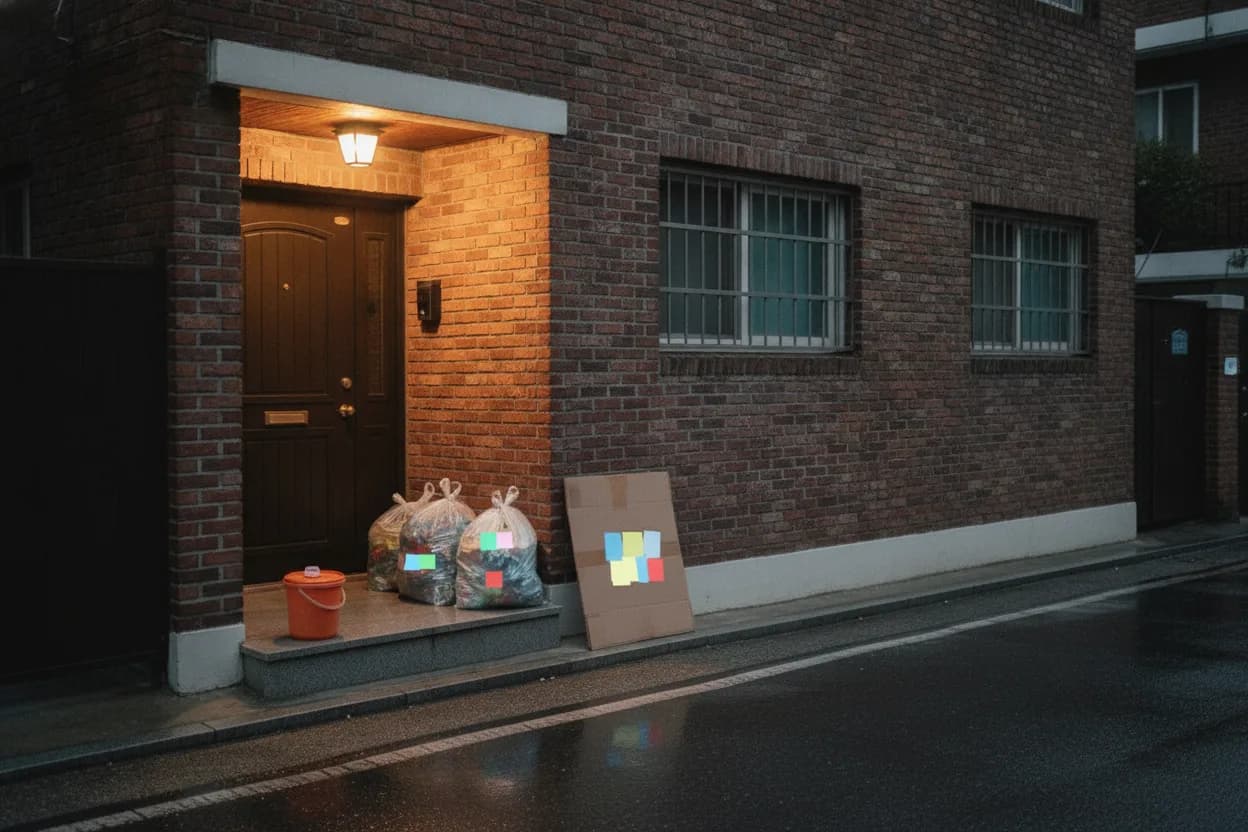
A collection night done right: white bags tied, recycling in a clear bag, cardboard flat, the yellow bag inside the orange bucket, all by your own door. Illustration.
Timing is set by the district. Yongsan-gu, which covers Itaewon and Haebangchon, publishes it plainly on its clean-up page:
| Rule | Yongsan-gu |
|---|---|
| Collection days | Sunday to Friday evenings |
| No collection | Saturday, and the evening before a public holiday |
| Window, side streets and alleys | 18:00 to 24:00 |
| Window, main roads | 22:00 to 01:00 |
| Where | In front of your own house or shop |
Mapo-gu, Seodaemun-gu and Gwanak-gu run the same Sunday-to-Friday evening pattern with small differences in the hours; the notice by your building's entrance or the district website is the source of truth. The habit to build: bags go out after dinner on the night before you want them gone, and never on a Saturday.
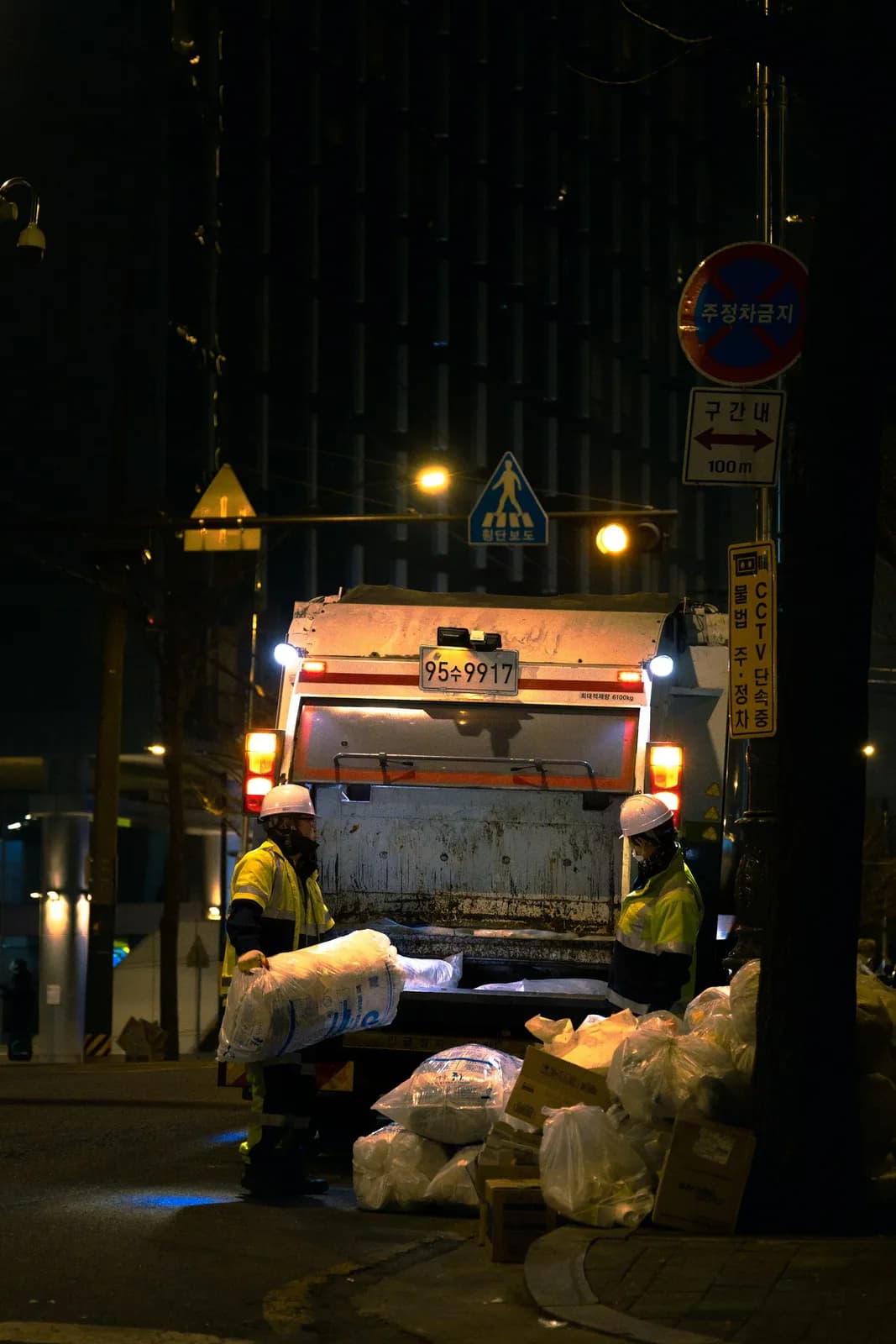
The truck comes through after midnight. Anything not in the right bag stays on the kerb with a sticker on it. Photo: Janice Kwong / Unsplash.
What are the fines, and who is watching?
Every Seoul district enforces the same schedule from the Wastes Control Act. Geumcheon-gu's published table is representative:
| What you did | 1st offence | 2nd | 3rd |
|---|---|---|---|
| Household waste in the wrong bag, mixed with food waste, or put out at the wrong time or place | ₩100,000 | ₩200,000 | ₩300,000 |
| Dropping a cigarette butt, tissue or other small litter | ₩50,000 | ₩50,000 | ₩50,000 |
| Dumping trash in a shopping bag or other unofficial container | ₩200,000 | ₩200,000 | ₩200,000 |
| Dumping from a car or hand cart | ₩500,000 | ₩500,000 | ₩500,000 |
| Dumping business waste, or burning or burying waste | up to ₩1,000,000 |
Two things make this real rather than theoretical. First, the cameras. Districts install sensor-triggered CCTV with loudspeakers at habitual dumping spots; Dobong-gu alone runs 228 of them, and the boards play a recorded warning the moment someone approaches with a bag. Second, the neighbours. Anyone can report illegal dumping through the district office or the government service portal, and if the report leads to a fine the reporter is paid a share of it. Jung-gu pays 20 percent for litter and 30 percent for everything else, up to ₩500,000 per person a year, for reports filed within 14 days with evidence that identifies the person. A neighbour with a phone is an enforcement officer.
In practice, a first-time newcomer who has the right bags and merely got the day wrong tends to get a sticker on the bag and a word from the building manager, not a fine. The fines land on the wrong bag and the wrong place, because both look like dumping on camera.
How do you throw away clothes, furniture, electronics and the awkward stuff?
Clothes and textiles go in the green metal clothing collection bins (의류수거함) that stand on residential streets. Seoul's guidance lists what fits: worn clothes, shoes in pairs, bags, bed sheets, soft toys, thin blankets, household carpets, curtains and rugs, as long as they fit through the slot. Not accepted: pillows and padded cotton duvets, cushions, latex bedding, electric blankets, pet bedding, roller skates or ski boots. Once something is in the bin it belongs to the operator; taking things out counts as theft.
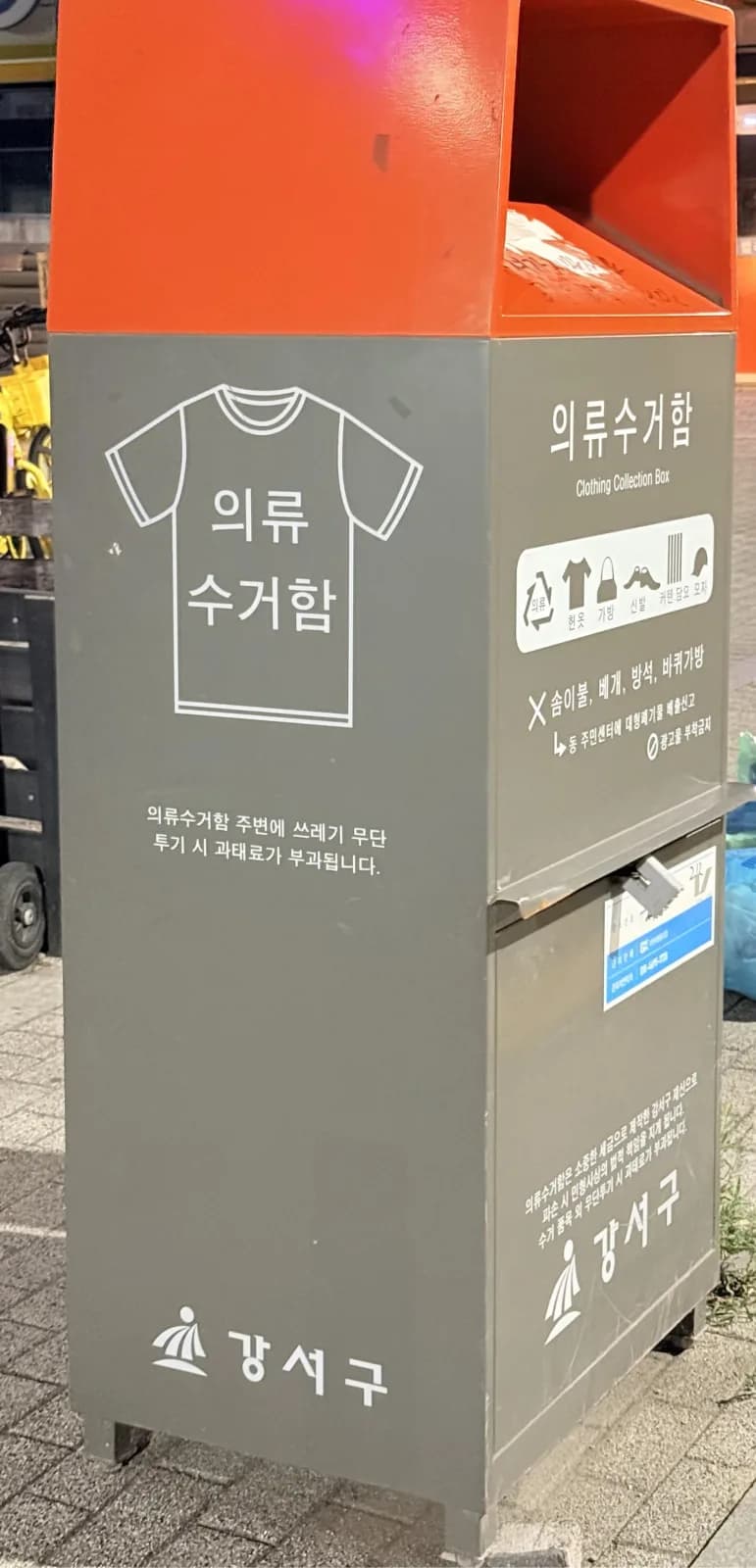
A district clothing collection box. The icons show what it takes: clothes, bags, shoes, curtains, blankets, hats. The crossed-out line names what it refuses: padded duvets, pillows, cushions and wheeled bags, which go to the community centre as large waste. The small print warns that dumping trash beside the box is fined.
Furniture, mattresses, suitcases and anything too big for a bag are large waste (대형폐기물). Declare the item and pay the fee online at your district website or in the 빼기 app, or buy a paper sticker at the community centre, then attach the number to the item and put it at the kerb on the date given. Fees run from about ₩2,000 for a chair to ₩30,000 for a king mattress and vary by district.
Fridges, washing machines, TVs, air conditioners and other large appliances are collected free. Book at 15990903.or.kr or call 1599-0903, and the crew takes the unit from your door at no charge as long as it is intact; Seoul's notice on the service explains the scheme. Do not pay a hauler for this.
Batteries and fluorescent tubes go in the dedicated boxes at your community centre (주민센터) or apartment recycling station, never in a bag. Expired medicine goes back to a pharmacy or public health centre collection box, not down the sink. Cooking oil in small amounts is soaked into paper towel and put in the white bag; larger amounts go to the community centre's oil collection.
What is different when you live in a share house?
The mechanics are the same; the difference is that someone has already answered the questions. At a SharedHomies house the manager shows you the spot by the door on your first day, the house keeps a stock of the right district bags, the orange bucket is already there, and the collection days are on the fridge. Your job is the sort: white bag, yellow bag, clear bag, tied, out after dinner on a collection night, food waste in the bucket.
Two habits keep a shared kitchen civilised. Freeze your scraps rather than leaving them in the bin under the sink, and rinse before you recycle so nobody has to re-sort your bottles. If you are moving in for a semester or a first job and want the rest of the landing covered, the first 30 days checklist and the guide to what fully furnished actually includes both start where this one ends. The winter gas bill guide is the other household number worth knowing before December, and the wider picture of daily life in Seoul and how renting works sit in their own guides.
Trash is the first Korean system most newcomers have to master alone, and it is the one they end up proud of. A month in, you will be the person explaining the yellow bag to someone else.
Frequently asked questions

A team of foreigners and Koreans operating shared homes across Seoul. We write what we learn from running a co-living business for international tenants.
We reply within 24 hours · ★ 5.0 on Google Reviews
or browse the houses first →